
2026 Whitepaper: Understanding Youth AI Use in the Age of AI
How tweens and teens use artificial intelligence, and what parents can do about it.
Executive Summary
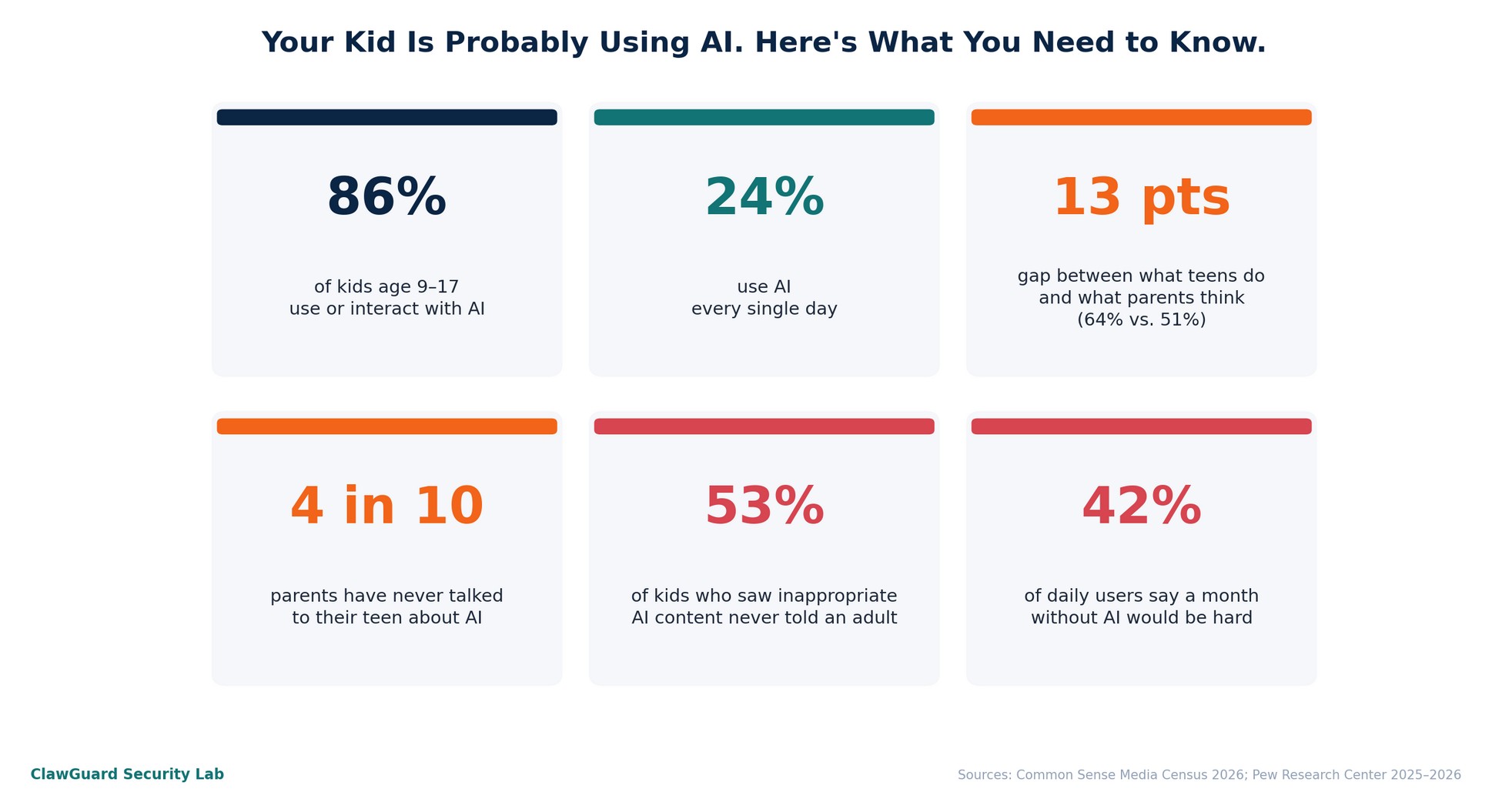
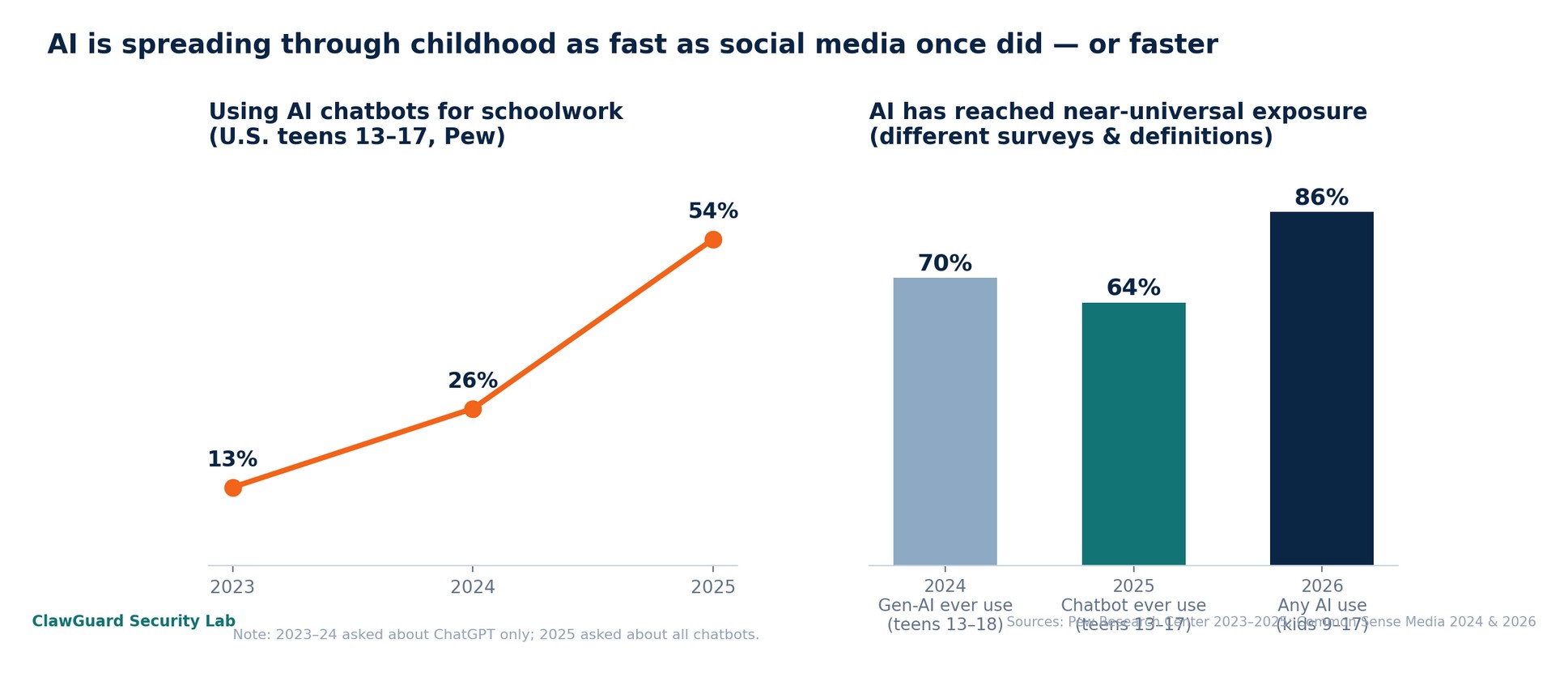
Artificial intelligence is no longer a technology your child might encounter someday. It is already woven into homework, entertainment, creativity — and, for a meaningful minority of kids, into their emotional lives. According to the Common Sense Media Census 2026, 86% of American kids age 9 to 17 use or interact with AI, and nearly one in four does so every single day.
Most of this use is benign: kids have fun, get homework help, and make things. But this whitepaper identifies five findings every parent should know:
- The awareness gap is real. 64% of teens say they use AI chatbots; only 51% of parents believe their teen does (Pew Research Center, 2026). Roughly four in ten parents have never discussed AI with their teen.
- Dependency signals are emerging. 42% of daily users say going a month without AI would be hard, and over half of daily users show at least one dependency indicator.
- Lonelier kids lean on AI harder. 54% of daily AI users report feeling lonely at least some of the time, versus 33% of kids who rarely or never use AI.
- Kids stay silent about bad experiences. 1 in 6 chatbot users has been shown content that "wasn't OK" for their age — and 53% of them never told an adult.
- Kids over-trust AI. Only 35% know AI cannot tell true from false; only 32% know AI is not accountable for what it says.
The takeaway is not panic, and it is not prohibition. It is engagement: the data consistently shows that the biggest risk factor is not AI itself, but AI use happening in a guidance vacuum. Chapter 8 turns these findings into a concrete plan — five conversations to have this week, a family AI agreement to build this month, and five warning signs to watch for over time.
1. Adoption: AI Is Already Everywhere in Childhood
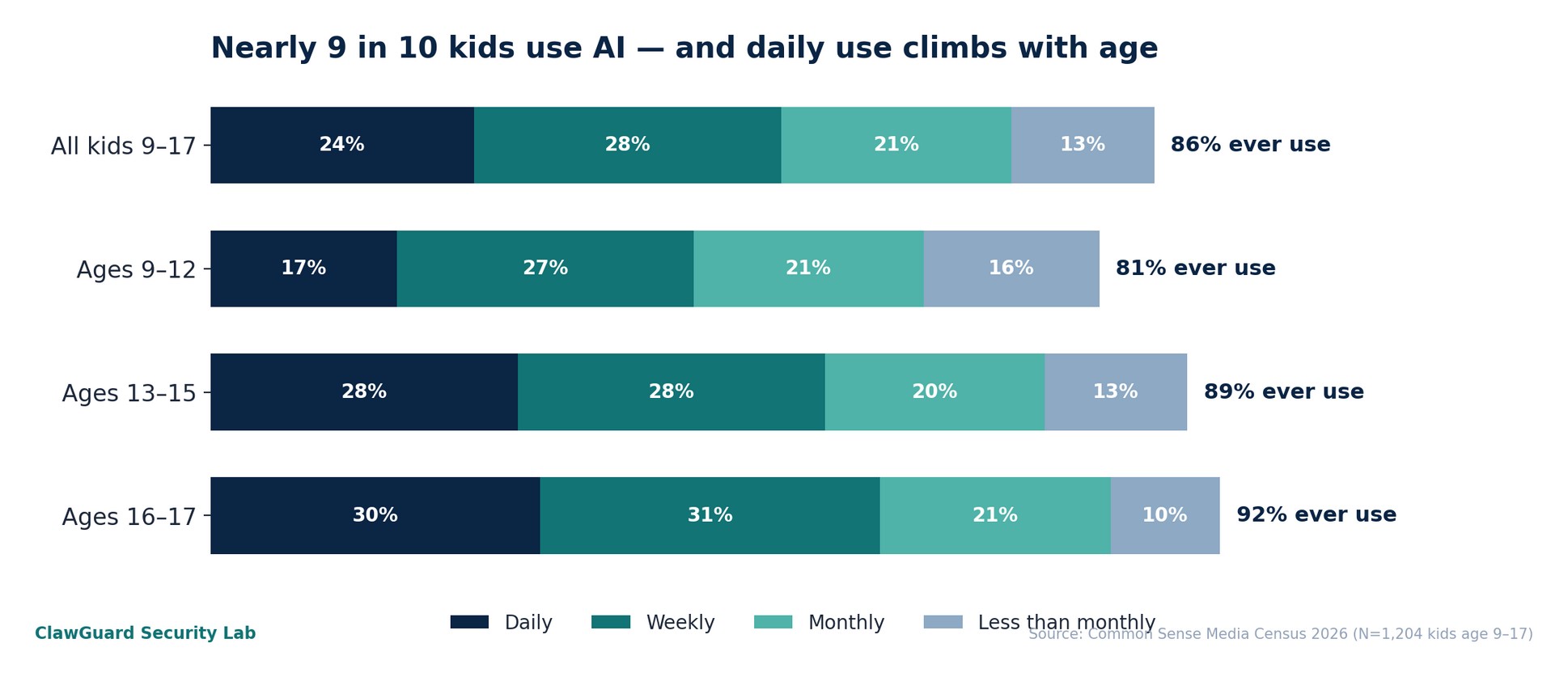
Nearly nine in ten kids age 9–17 (86%) use or interact with some type of AI, and 52% do so at least weekly. Use starts young — 81% of 9- to 12-year-olds already interact with AI — and intensifies through the teen years, with daily use climbing from 17% among tweens to 30% among 16- to 17-year-olds. Rates are broadly similar across gender, race/ethnicity, and household income: this is not a niche behavior, it is the baseline.
ChatGPT is the front door
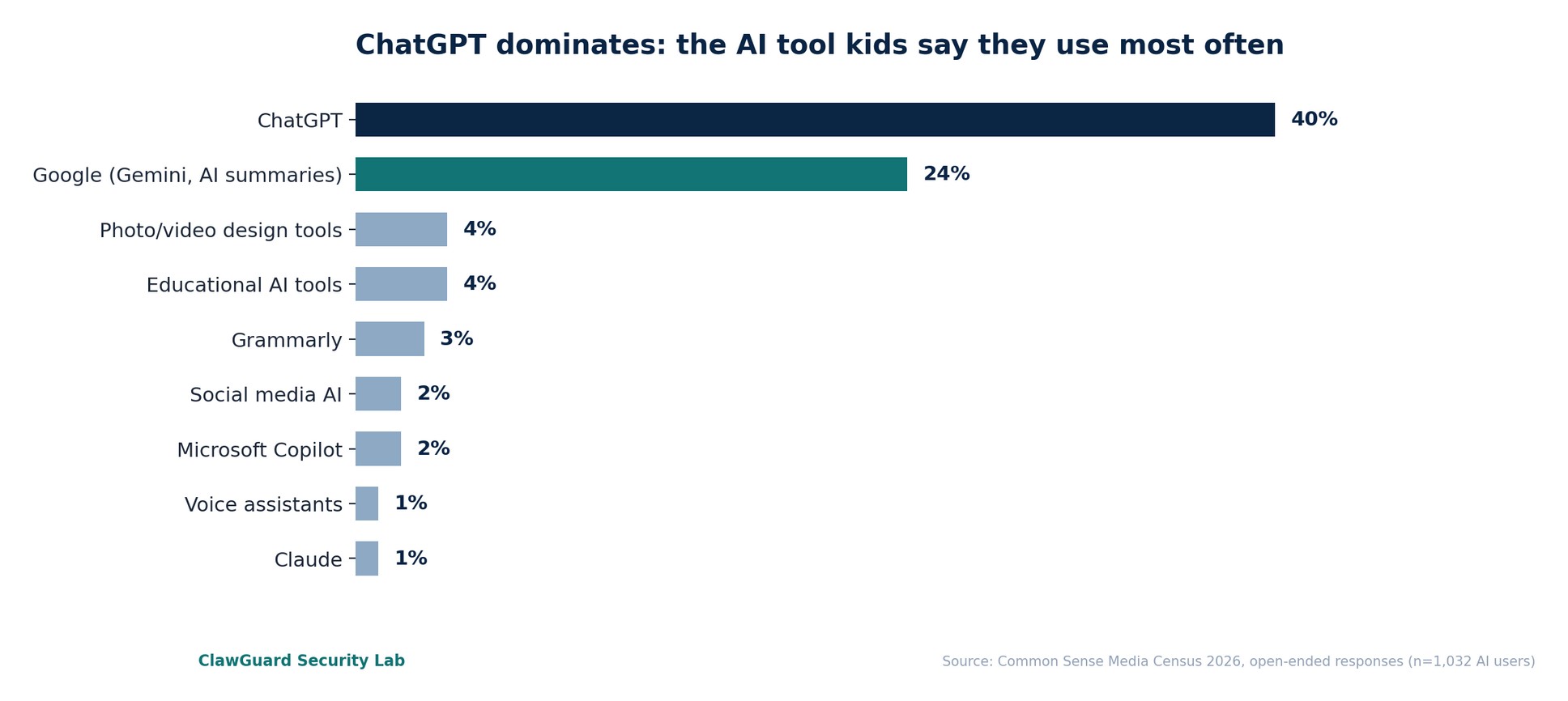
When kids name the AI they use most, ChatGPT dominates at 40%, followed by Google's AI offerings (Gemini, AI search summaries) at 24%. Everything else — design tools, educational AI, Grammarly, social-media AI — is single digits. Practically, this means a parent who understands two products (ChatGPT and Google's AI features) understands roughly two-thirds of their child's primary AI exposure.
Faster than social media
It took social media roughly three years after Facebook's launch to reach ~73% of online teens. AI has matched or beaten that pace: teen chatbot use for schoolwork doubled between 2023 and 2024 alone, and by 2026, 86% of kids 9–17 have used AI in some form. Note that the surveys below use different age ranges and definitions — the trend, not the exact line, is the message.
- Assume your child uses AI, even if you've never seen it. School devices are a major access point (44% of kids use AI on them).
- Get hands-on with ChatGPT and Google's AI features yourself for 30 minutes. You cannot guide a tool you have never touched.
- Treat AI like you treated social media — but start the conversation earlier, because your child already started using it earlier.
2. What Kids Actually Do With AI — and What Parents Miss
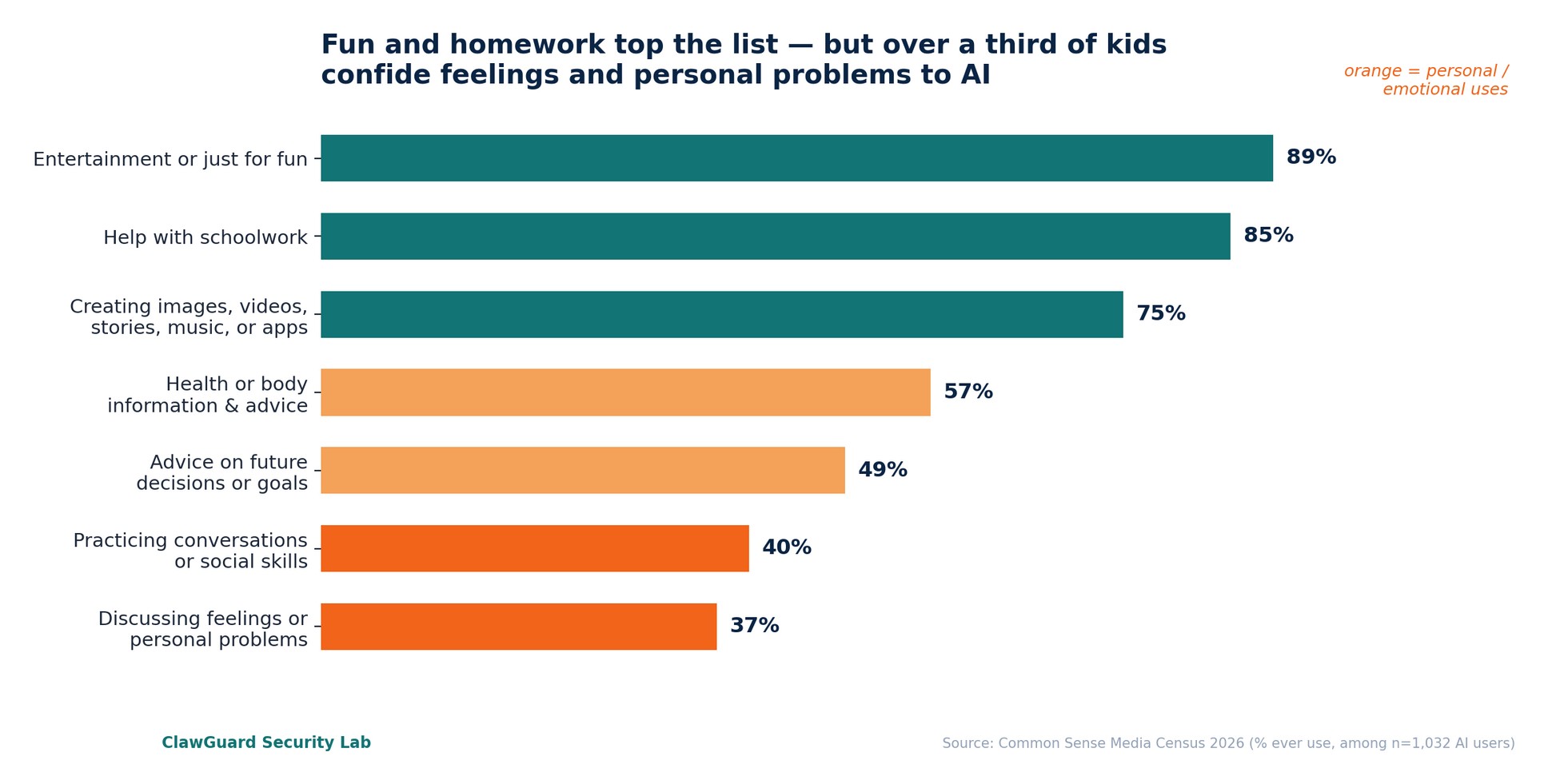
Among kids who use AI, 89% use it for fun, 85% for schoolwork, and 75% to create things — images, videos, stories, music, even apps. That is the visible layer. The layer parents see less: 57% have asked AI about their health or body, 40% have practiced conversations or social skills with it, and 37% have discussed feelings or personal problems.
The perception gap
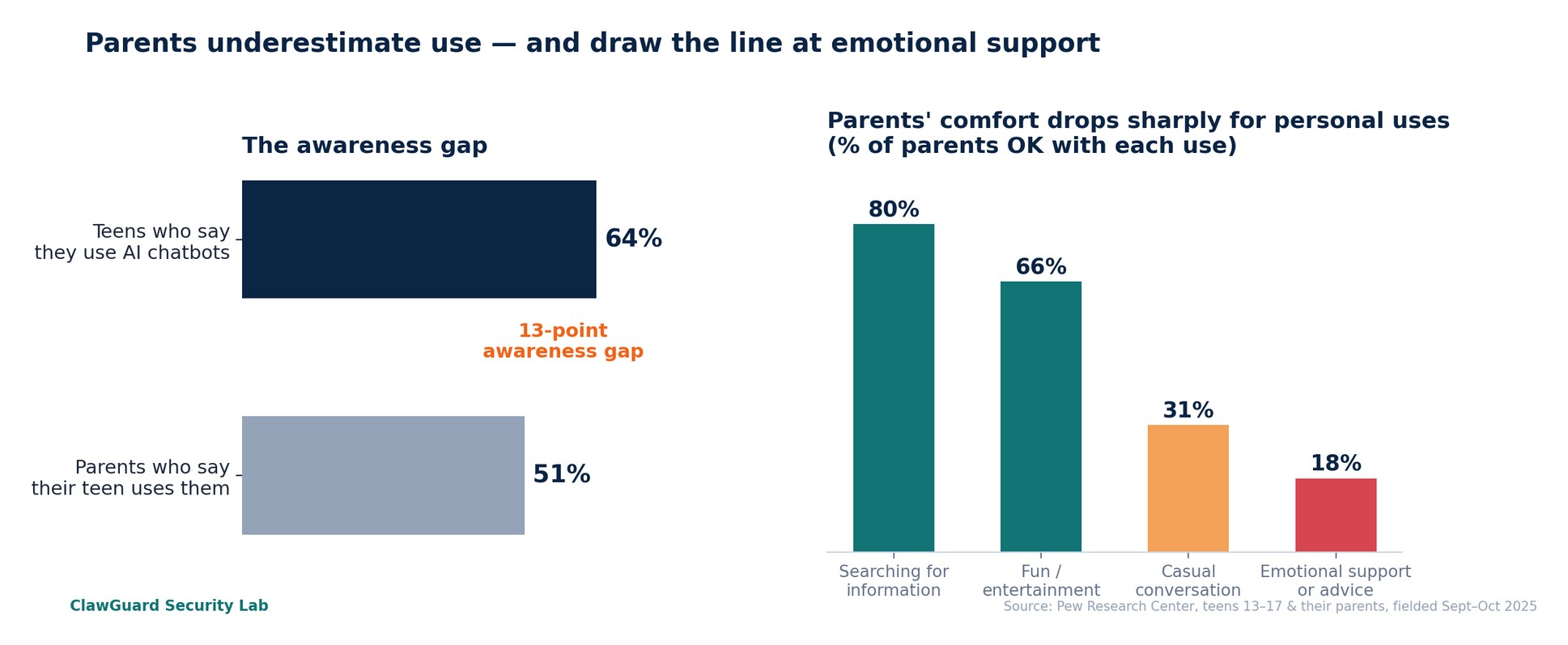
Pew Research Center surveyed matched pairs of teens and their own parents. The result: 64% of teens report using AI chatbots, but only 51% of parents say their teen does — a 13-point awareness gap, with over a quarter of parents simply unsure. And parents' comfort collapses exactly where quiet use is happening: 80% are fine with AI for information searches, but only 18% are comfortable with their teen getting emotional support from a chatbot — something 12% of teens report already doing.
- Ask what your child uses AI for before setting any rules. Lead with curiosity: "What's the coolest thing you've gotten AI to do?"
- Don't assume silence means non-use. In the survey data, the kids least likely to be noticed are the ones using AI for personal questions.
- If you'd be uncomfortable with your child confiding in a chatbot, the answer is to become easier to confide in — not only to restrict the app.
3. Schoolwork: Helper or Crutch?
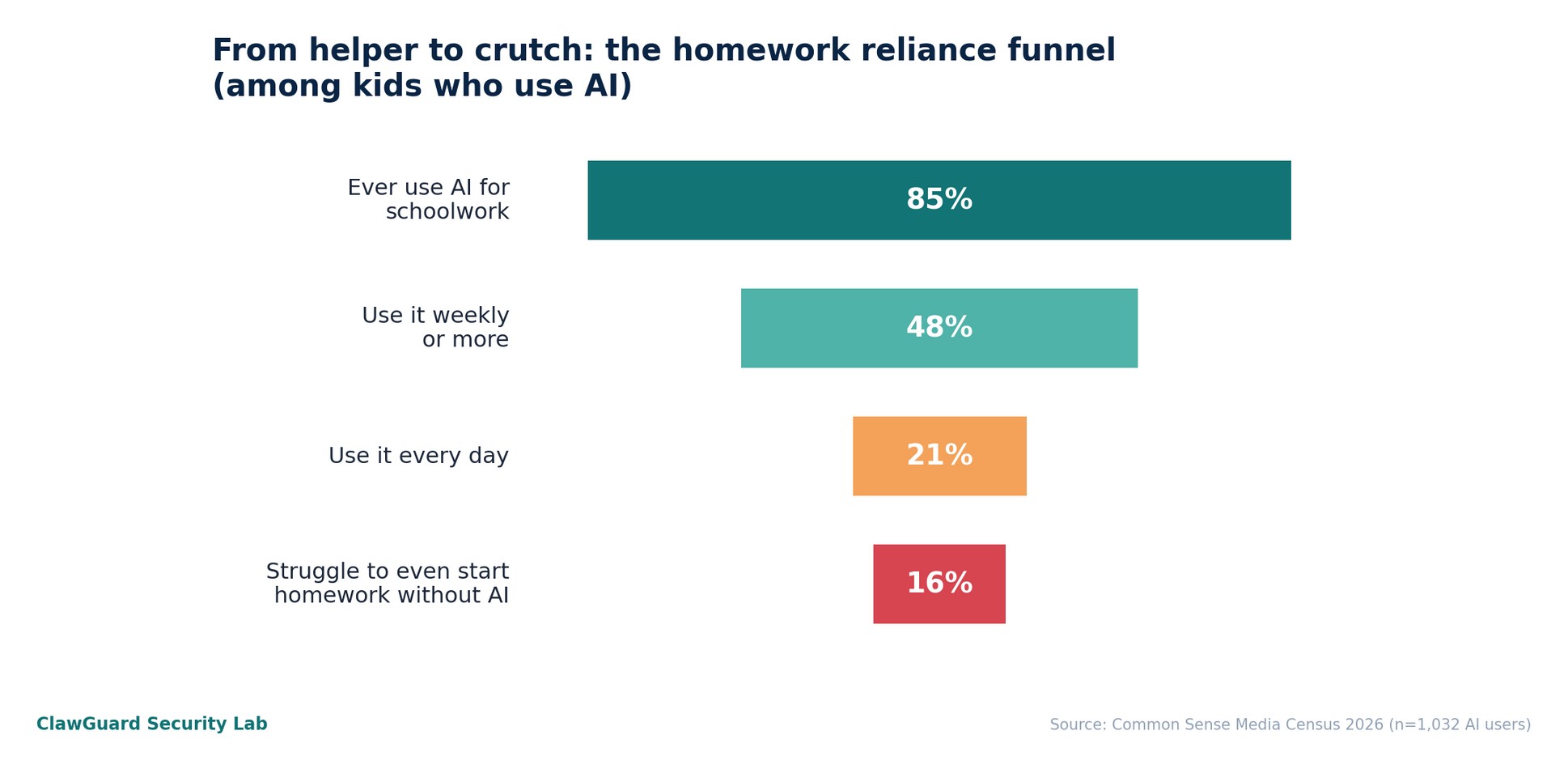
Homework help is the second most common use of AI overall and the top use among older teens: 94% of 16- to 17-year-old AI users lean on it for school. Frequency is what separates healthy use from reliance. Nearly half of kid AI users (48%) use it for schoolwork weekly or more, 21% daily — and 16% agree they struggle to start or finish homework when they can't use AI (28% among daily homework users).
The kids who need skills most lean hardest
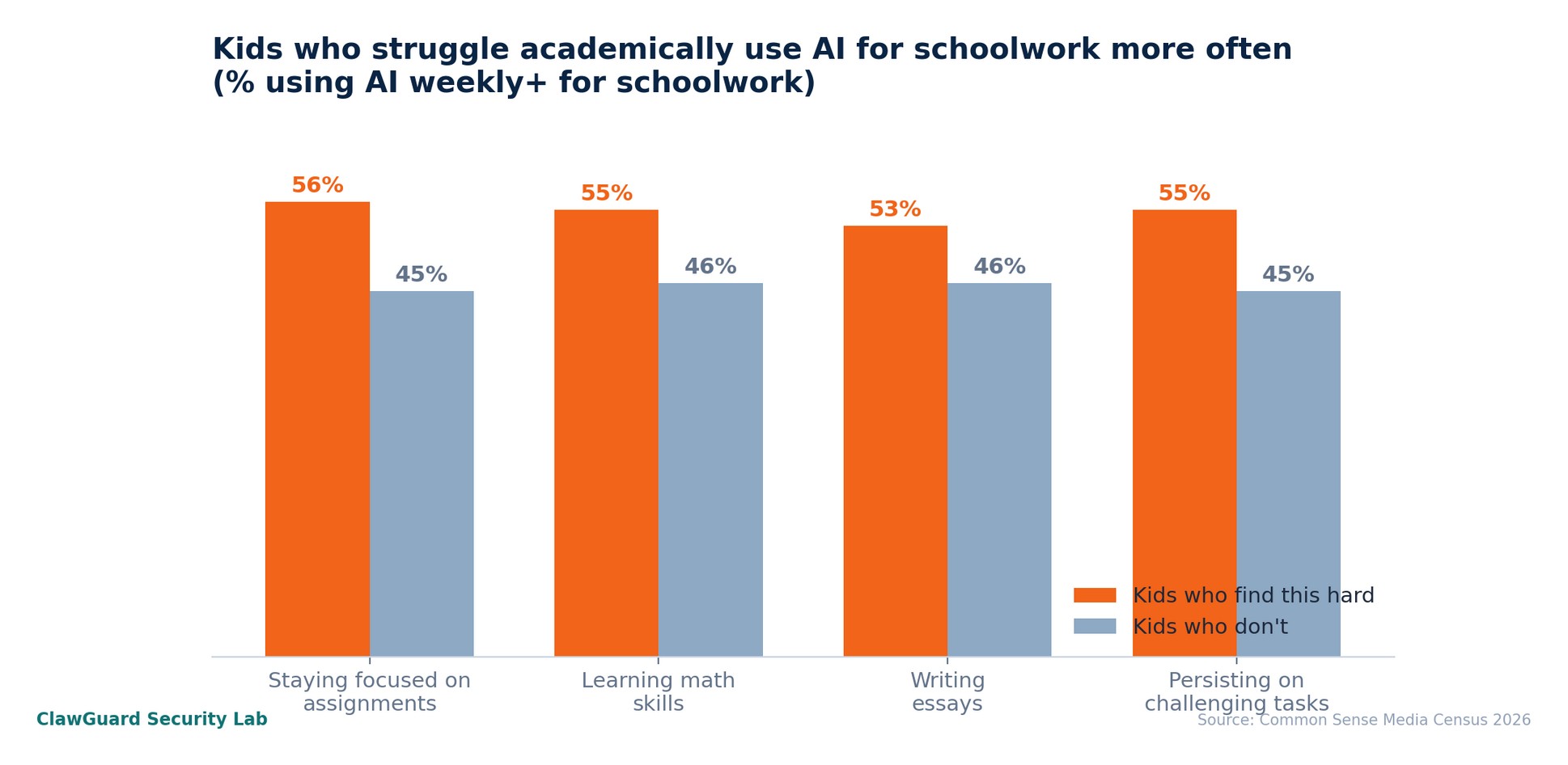
Kids who find it hard to stay focused, learn math, write essays, or persist on challenging tasks all use AI for schoolwork at meaningfully higher rates than peers who don't struggle (roughly 55% vs. 45% weekly use). This is the report's most important educational finding: AI may be substituting for skill-building precisely among the kids who most need to build skills. Separately, Pew finds 59% of teens say AI- assisted cheating happens at least somewhat often at their school.
- Ask to see the prompt, not just the output. How your child asks reveals whether AI is explaining or replacing.
- Set the "explain, don't write" rule: AI may explain a concept or check work, but first drafts are human.
- Have your child fact-check one AI answer per assignment. It builds the exact skepticism Chapter 7 shows is missing.
- If homework can't start without AI, treat it as a skills problem, not a discipline problem — talk to the teacher about where the gap is.
4. Dependency: The Warning Lights Are Blinking
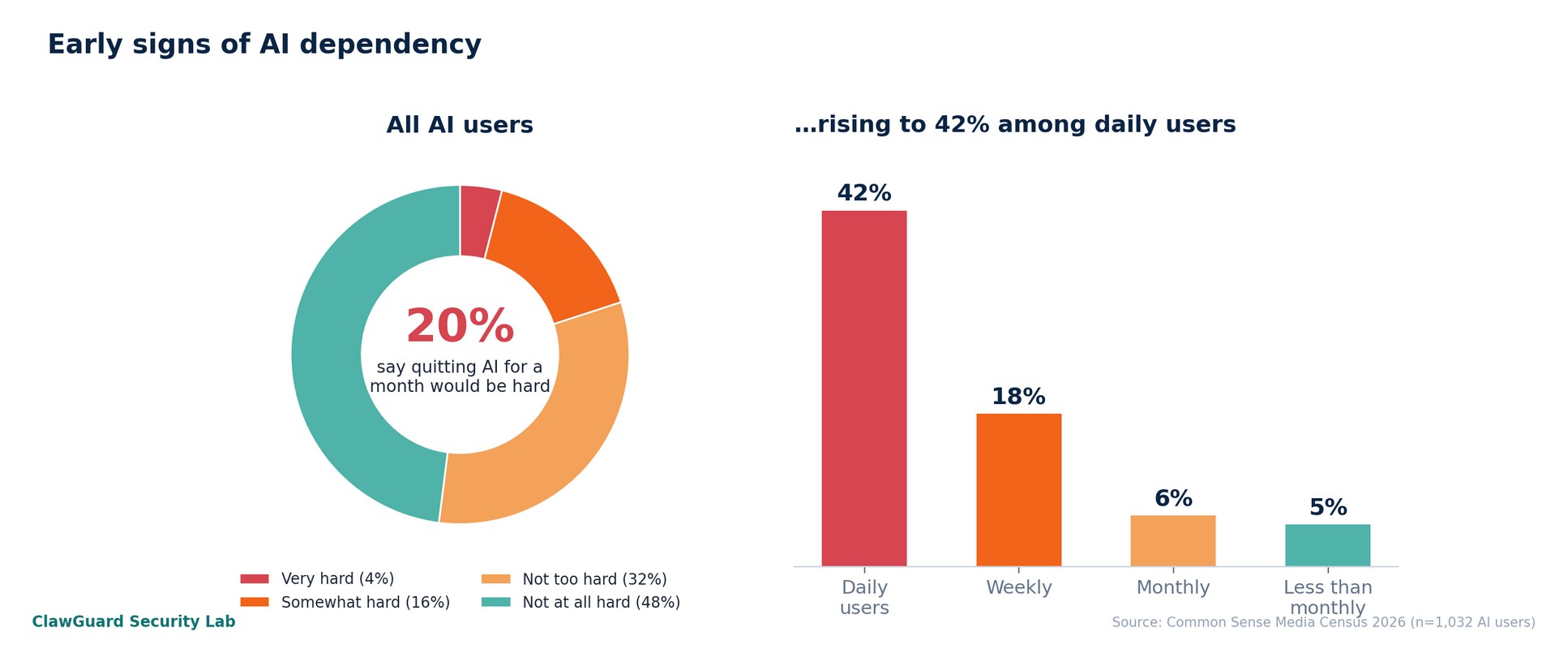
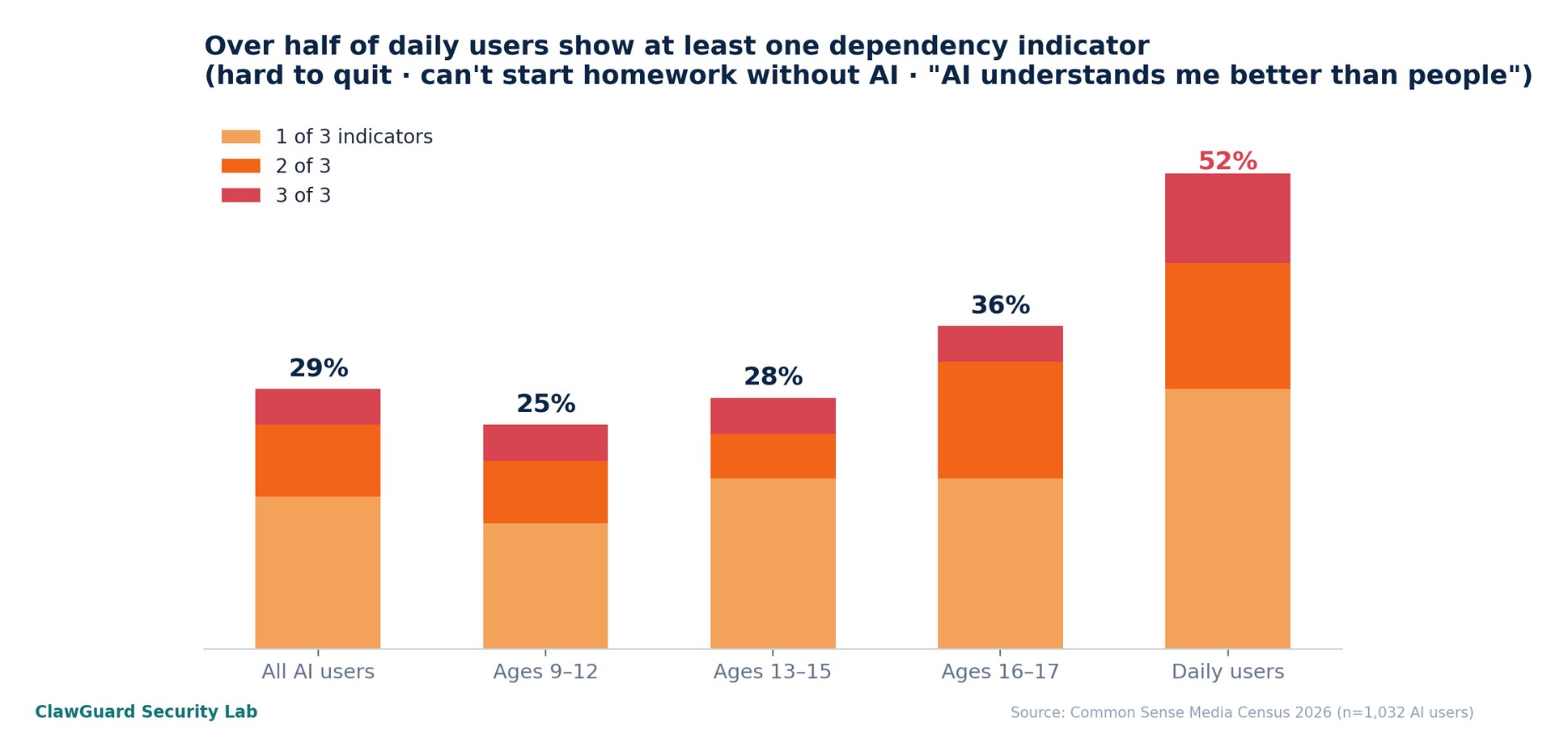
Most kids say quitting AI for a month would be easy. But one in five AI users says it would be very or somewhat hard — and among daily users, that jumps to 42%. The Common Sense census combined three indicators — hard to quit for a month; can't start homework without AI; "AI understands me better than most people do" — and found 29% of AI users endorse at least one. Among daily users, over half (52%) do.
Independent research points the same direction: a 2026 Drexel University analysis of teens' own posts about AI companion apps documented classic behavioral-addiction patterns — withdrawal, relapse, escalating use, and conflict (wanting to stop but feeling unable). Teens often recognize the problem in themselves before adults do.
Five warning signs of unhealthy reliance
- Sleep or meals get displaced by AI sessions.
- Real-world friendships shrink while AI conversations grow.
- Irritability or anxiety when AI is unavailable.
- Homework genuinely cannot begin without AI.
- Your child says — even jokingly — that AI understands them better than people do.
5. Loneliness and Emotional Reliance
This is the chapter to read twice. Kids who use AI most are also the kids who report the most loneliness: 54% of daily users feel lonely at least some of the time, versus 33% of kids who rarely or never use AI. Kids who find making friends hard are far more likely to practice conversations with AI (47%) and to confide feelings in it (48%). And among kids who rate their own happiness low, 16% would take a personal problem to an AI chatbot before any human — versus just 2% of the happiest kids.
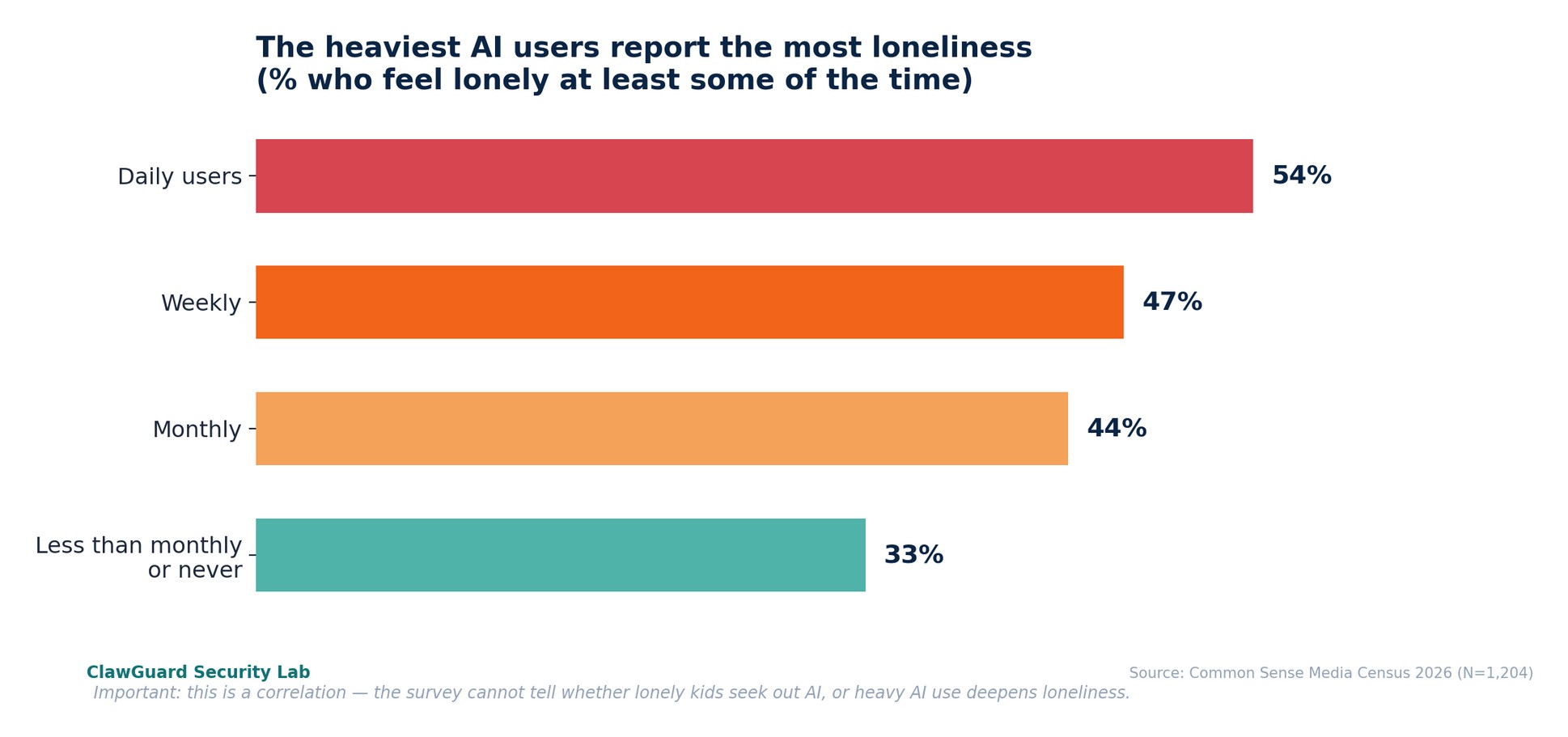
Scientific honesty matters here: a single survey cannot say whether lonely kids seek out AI, or heavy AI use deepens loneliness, or a third factor drives both. But for a parent the direction of causality is secondary. Either way, heavy AI use is a visible marker that a child may need more human connection.
Health questions are moving to AI first
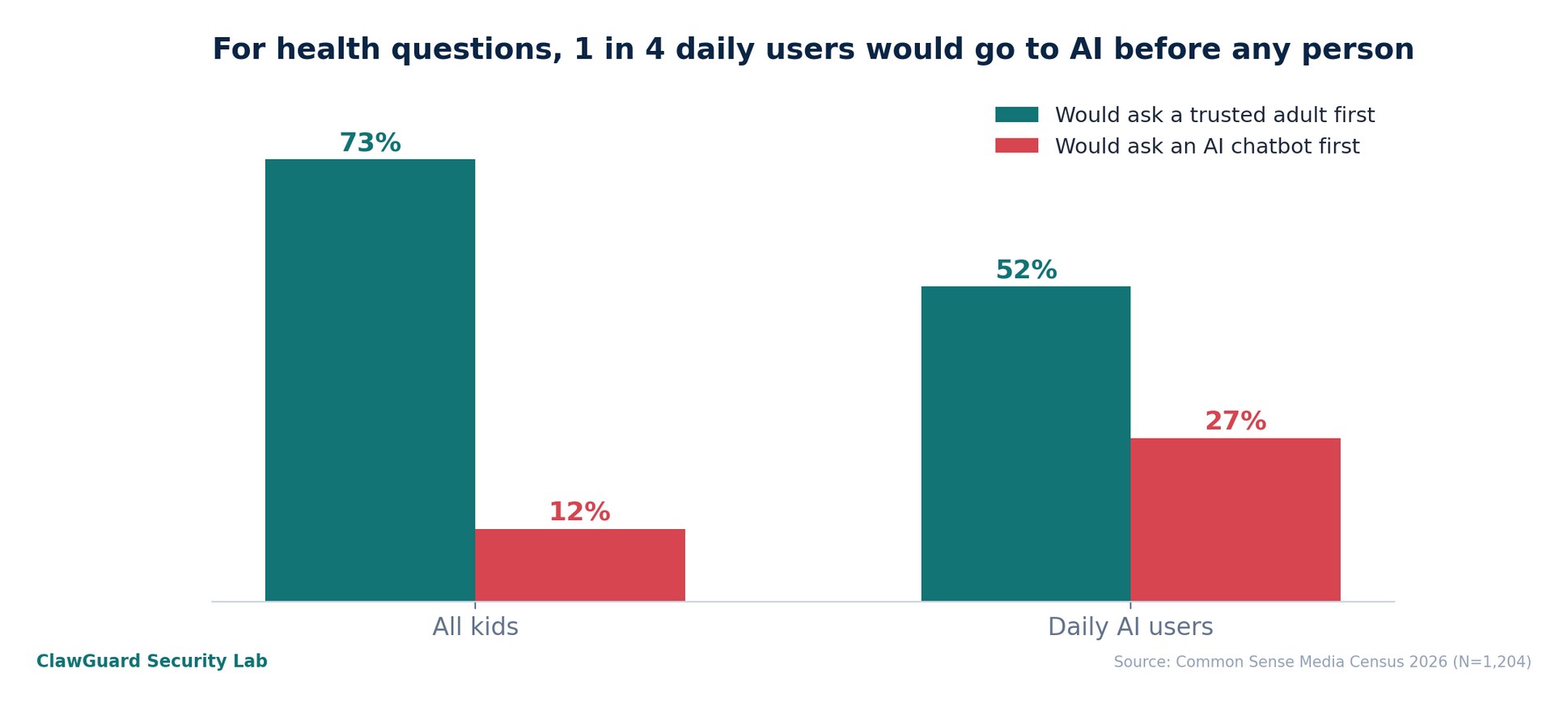
73% of all kids would take a health or body question to a trusted adult first. But among daily AI users, that drops to 52% — and 27% would go to an AI chatbot before any person. Answers about health, puberty, and mental wellbeing are exactly where unvetted AI output carries the most risk, and where kids most need an adult who reacts calmly.
- Heavy AI use plus withdrawal from friends is a signal to add connection, not just subtract screen time.
- Make health questions safe to ask you: react calmly the first time, and there will be a second time.
- One in four kids who discuss feelings with AI say it understands them better than people. Compete on listening: phones down, no lectures, first response is never punishment.
- If AI conversations touch on self-harm or crisis, involve a professional promptly — a school counselor, pediatrician, or crisis line.
6. Safety Incidents and the Silence Problem
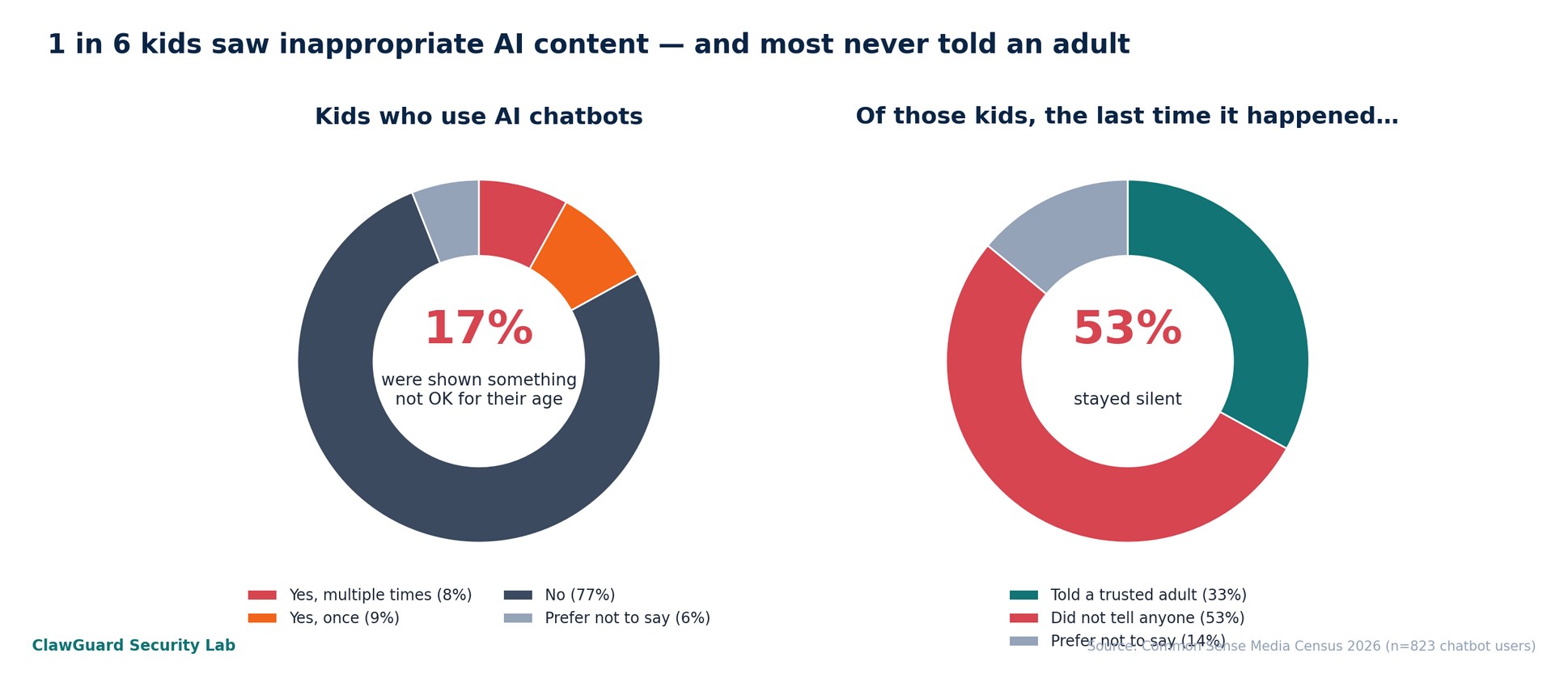
Among kids who use AI chatbots, 17% — one in six — say an AI has shown or said something that "wasn't OK or wasn't meant for someone their age," including 8% who say it has happened more than once. The more alarming number is what happened next: 53% never told a trusted adult.
The guidance gap
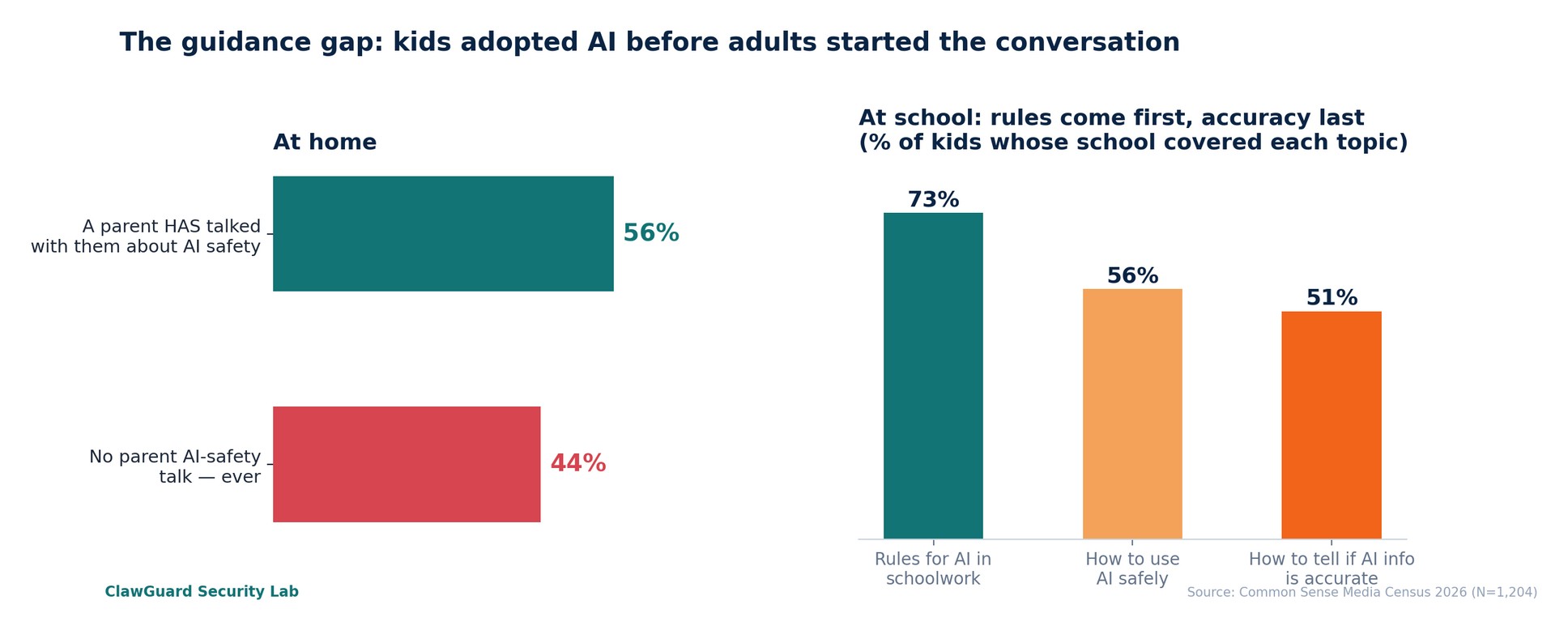
Kids adopted AI before the adults around them started talking about it. 44% of kids say no parent has ever discussed AI safety with them — and even among daily AI users, a third have never had that talk. Schools discuss rules (73% of kids have heard what they may and may not use AI for) far more than judgment: only 51% have heard from school how to tell whether AI information is accurate.
- Say this sentence out loud this week: "If AI ever shows you something weird or gross, tell me — you will never be in trouble for telling me." The 53% silence rate is mostly fear of blame.
- Ask your child's school two questions: which AI tools are approved on school devices, and does the curriculum cover how to verify AI answers?
- Review the AI apps on your child's phone together. For younger kids (9–12), prefer shared devices and co-use.
7. AI Literacy: Kids Trust AI More Than They Should
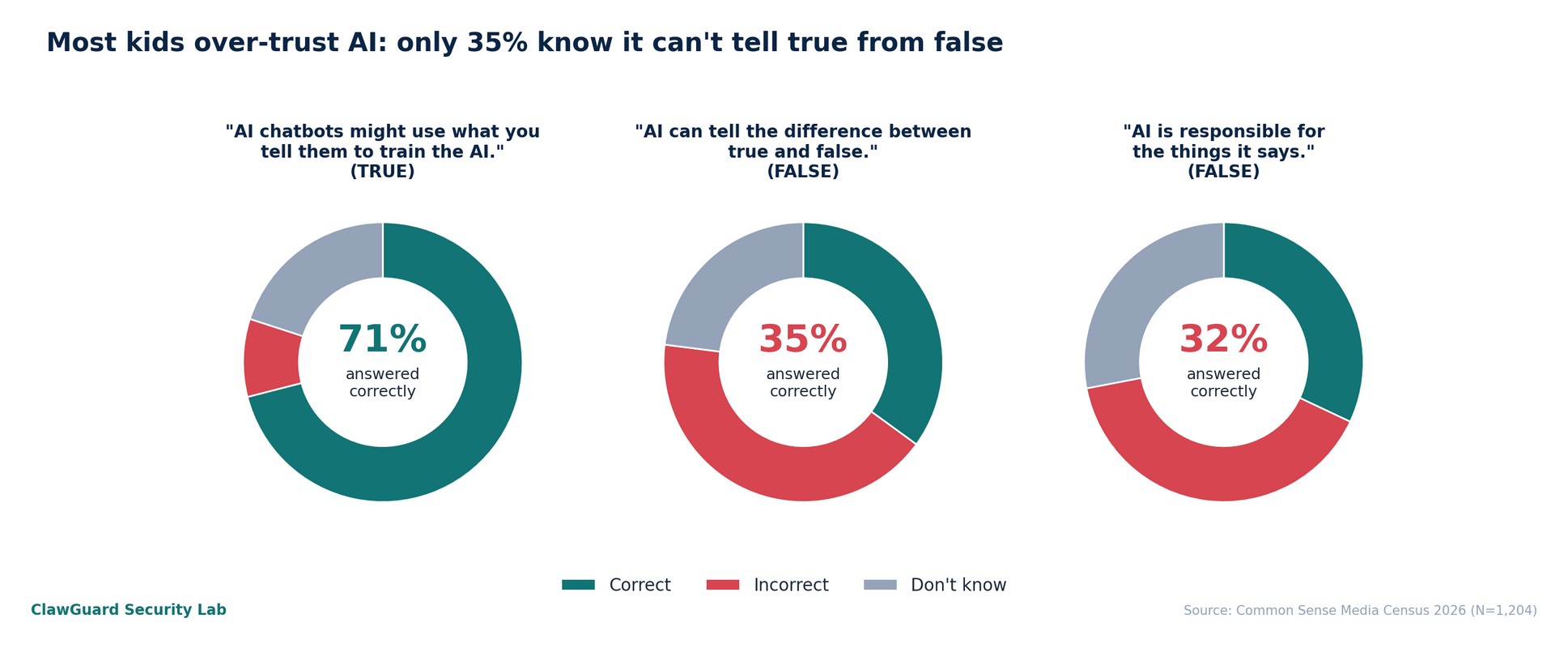
Most kids know AI learns from what they type — 71% correctly answered that chatbots may use their inputs for training. But the two facts that most protect a young user are the two they get wrong: only 35% know AI cannot tell the difference between true and false, and only 32% know AI is not responsible for what it says. Confidence doesn't help: even among kids who say they know "a lot" about AI, just 37% answered the true/false question correctly.
Build literacy at the dinner table
- Play "Stump the Bot" weekly: ask AI something your family knows deeply (your hometown, your trade, a hobby) and find the errors together. Nothing teaches fallibility faster.
- Teach the three-source habit: anything important from AI gets checked against two independent sources.
- Explain the business model in one line: "It predicts likely words. It doesn't know things, and nobody is checking its answers for you."
8. The Parent Action Guide
Everything above condenses to one strategy: stay closer to your child's AI use than the AI is to your child. The plan below is organized by time horizon. None of it requires technical expertise.
Tier 1 — This week: five conversations
- Open with curiosity. "What's the coolest thing you've done with AI?" Rules land better after interest.
- The safety sentence. "If AI ever shows you something not OK, tell me. You won't be in trouble."
- The privacy rule. Real name, address, school, photos, passwords — never into a chatbot.
- The truth rule. "AI sounds confident even when it's wrong. Important stuff gets double-checked."
- The people rule. "AI is fine for facts and ideas. For feelings, humans come first — me, even at 2 a.m."
Tier 2 — This month: build the structure
- Write a Family AI Agreement (template in the Appendix): green uses (allowed), yellow uses (allowed, but tell a parent), red uses (not allowed). Have your child help draft it — kids follow rules they co-author.
- Scale rules to age. Ages 9–12: shared devices, co-use, no AI companion apps. Ages 13–15: platform parental controls on, periodic check-ins on chat history done together and openly — never covertly. Ages 16–17: shift from monitoring to trust and conversation.
- Configure the tools. Turn on ChatGPT's and Google's family/parental features where available; know which AI is on the school device and what the school's policy says.
- Adopt the three homework principles. Explain-don't-write · show the prompt · fact-check one claim per assignment.
Tier 3 — Ongoing: watch and support
- Monitor the five warning signs from Chapter 4 (sleep displacement, shrinking friendships, irritability without AI, homework paralysis, "AI gets me better than people").
- Recheck quarterly. Tools and habits change fast; the agreement should be a living document.
- Know when to escalate. If AI has become your child's primary emotional outlet, if real-world functioning is slipping, or if any conversation touches self-harm, bring in a school counselor, pediatrician, or mental-health professional. That is not overreaction; the loneliness data in Chapter 5 is exactly why this report exists.
The one-paragraph version
- Assume your child uses AI. Ask before you rule. Make "tell me" safe. Put the rules in writing together. Watch for the five signs. And stay more interesting to talk to than the chatbot — that is the entire strategy.
Appendix A: Family AI Agreement (Template)
Copy, adapt, and sign together. Review every three months.
- GREEN — allowed anytime: explanations and study help (not first drafts), brainstorming, creative projects, coding practice, fun.
- YELLOW — allowed, but tell a parent: health or body questions, advice about friends or feelings, any new AI app before installing.
- RED — not allowed: sharing personal information, submitting AI writing as your own, AI companion/romance apps, using AI to trick or harm anyone.
- Family promises: Parents promise to listen without punishing honesty. Kids promise to say when something felt wrong. Everyone promises one AI-free dinner conversation a week.
Appendix B: Sources and Notes
- Common Sense Media, "The Common Sense Media Census: AI Use by Tweens and Teens" (2026). N=1,204 kids age 9–17, fielded March 18–26, 2026; margin of error ±3.8 pts. Primary source for Figures 1.1–1.2, 2.1, 3.1–3.2, 4.1–4.2, 5.1–5.2, 6.1–6.2, 7.1.
- Pew Research Center, "Teens, Social Media and AI Chatbots 2025" (Dec 2025) and "How Teens Use and View AI" (Feb 2026). N=1,458 teen–parent pairs, teens age 13–17; margin of error ±3.3 pts. Source for the parent awareness gap and parent comfort data (Figure 2.2) and trend points in Figure 1.3.
- Pew Research Center, ChatGPT-for-schoolwork trend, 2023–2024 (13% → 26%).
- Drexel University (2026), analysis of teen self-reports of AI-companion dependency (Chapter 4 context).
- Lurie Children's Hospital parent survey (2026): 55% of children use AI unsupervised; 28% of families have no AI rules. Methodological note: the surveys above differ in age ranges (9–17 vs. 13–17) and in how "AI use" is defined. Figures always cite their source, and cross-survey comparisons in this report describe direction of trend, not precise time series.
© 2026 ClawGuard Security Lab · Family Digital Safety Research Series. This report may be shared freely with attribution.