
Inside Anthropic's IPO Roadshow: 42 Minutes and 38 Slides, Explained
Anthropic plans to list on Nasdaq as ANT, pricing on November 18. We walk through the 42-minute roadshow video and 57-slide deck along its own three themes (core advantages, enterprise adoption and the financial model), with 38 key slides, and close with what it all means for AI security.

Anthropic's IPO roadshow video surfaced on November 10: 42 minutes 43 seconds, 11 speakers and a 57-slide deck. The roadshow is built around three themes: core advantages, enterprise adoption of Claude, and what it calls an "unprecedented financial model." We follow the same structure, put each section's remarks next to the matching slides, and explain the reasoning behind each number. All figures come from the roadshow materials; we have not checked them line by line against the prospectus.
The short version
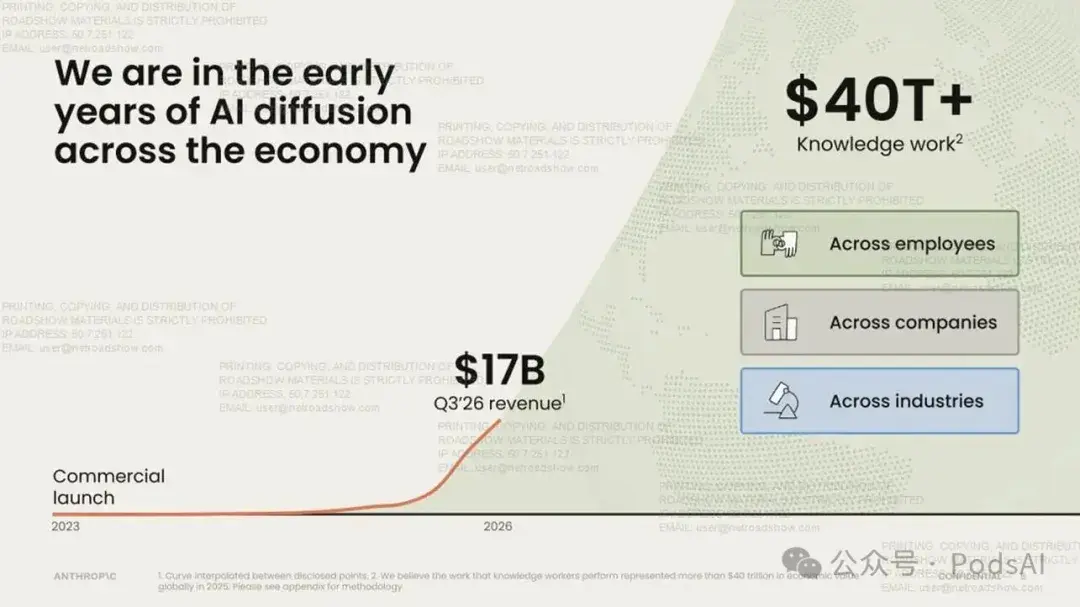
If you remember one thing, make it this: Anthropic wants investors to believe that its growth and its profits come from the same source, which is model capability. Better models mean customers find more uses for them, so revenue goes up. More efficient models mean the same compute serves more revenue, so margins go up. Quarterly revenue went from $376M in Q1 2025 to nearly $17B in Q3 2026, and over the same period adjusted operating margin climbed from -221% to 15%.
Two sets of numbers hold the story up. One is compute efficiency: over the past six quarters, revenue grew more than 45x while compute cost grew about 10x. The other is customer expansion: more than 11,900 enterprises now spend over $100K a year, and existing customers spend about nine times as much a year later. Yet Fortune 500 customers still spend on average less than 0.1% of their total expenses on Claude, so the ceiling is a long way off.
The other side of the story is the size of the bet. Anthropic has signed about $900B of compute contracts running through 2045. Claude already writes more than 90% of the company's code, and Anthropic said outright that it is approaching "recursive self-improvement." That is a selling point, and it is also what the AI security field most needs to watch over the next few years.
1. The offering and the opening
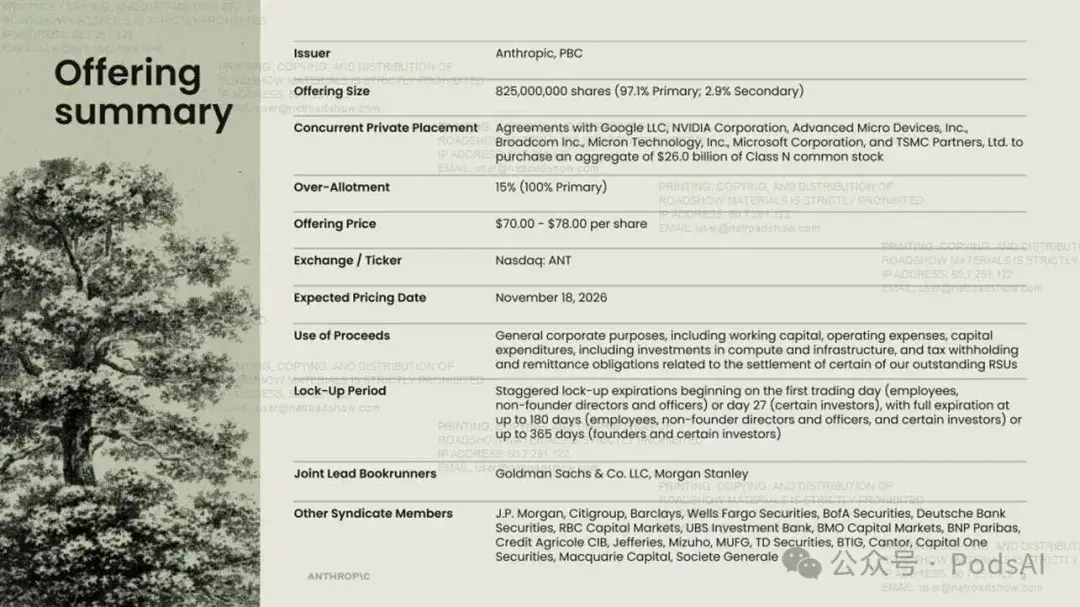
The offering is 825 million shares at $70–78 each, with pricing expected November 18 and a Nasdaq listing under the ticker ANT. 97.1% of the shares are newly issued by the company and only 2.9% are sold by existing holders, so this IPO is mainly about raising money for the company, not letting early backers cash out. There is also a 15% over-allotment option, all primary. Goldman Sachs and Morgan Stanley are joint lead bookrunners, followed by J.P. Morgan, Citigroup, Barclays, BofA and some twenty other banks.
The most interesting line is the concurrent private placement. Google, NVIDIA, AMD, Broadcom, Micron, Microsoft and TSMC are buying $26 billion of Class N common stock between them. That list is close to the entire AI compute supply chain, from chip design and memory to foundry and cloud. Suppliers becoming shareholders is a theme that comes back later in the multi-chip strategy and the long-term compute contracts.
The lock-up expires in stages, with the longest, 365 days, applying to founders and certain investors. The use of proceeds is broad: working capital, compute and infrastructure, and tax withholding when employee RSUs settle. The issuer is Anthropic, PBC, a public benefit corporation, which matters when we get to governance.
CEO Dario Amodei kept the opening short. He started with a timeline. In 2024 and 2025, AI coding became viable. Now, agents that complete tasks end to end are viable in other areas of knowledge work too. Next, fundamental discoveries in biology, math and physics are becoming possible.
Then he turned straight to risk: "If humanity can use AI to cure cancer, people with bad intentions can use AI to make bioweapons or launch cyberattacks. We cannot succeed unless we handle these risks." Talking about risk in the first minute of an investor roadshow is classic Anthropic, and it sets up an argument that runs underneath the whole presentation: safety is not a cost that slows growth, it is part of the growth.
2. Core advantages
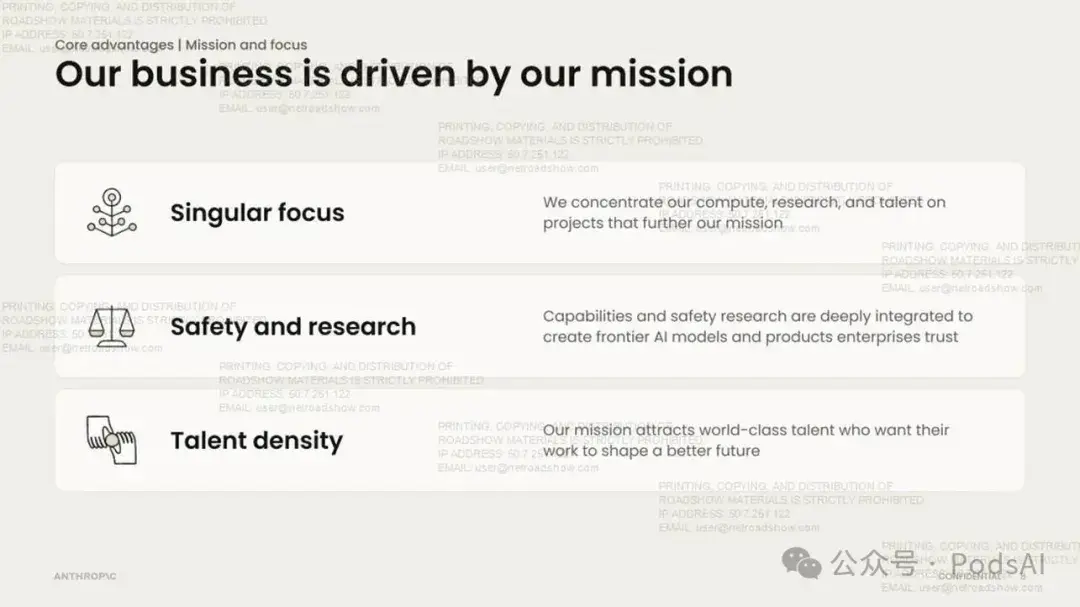
President Daniela Amodei took over and listed five advantages: mission and focus, talent and culture, frontier and safety research, approach to compute, and enterprise strategy. The first part of the roadshow walks through them in turn.
Mission: where limited resources go
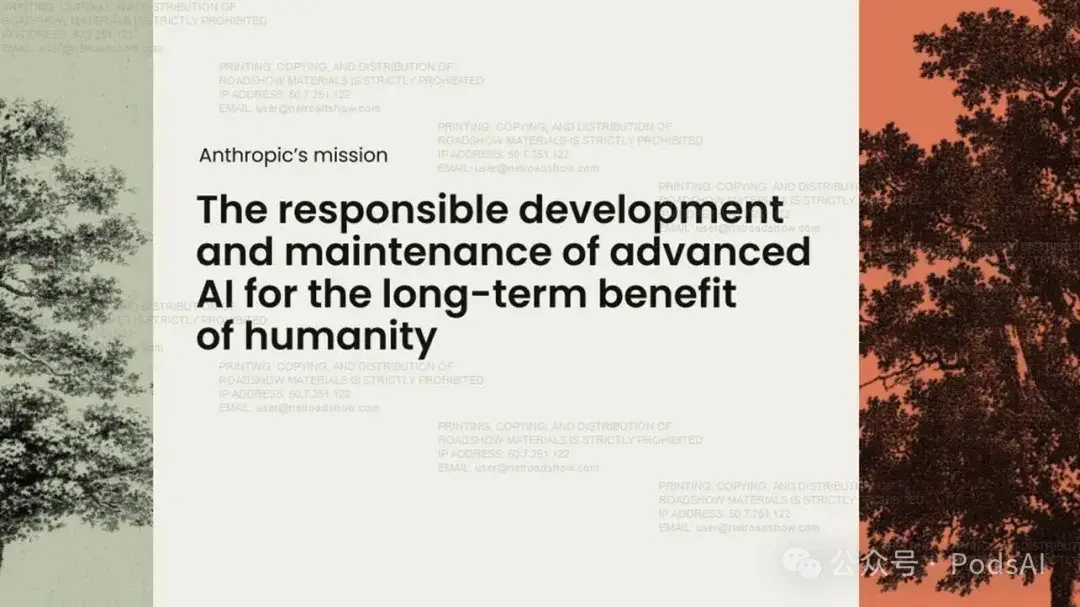
Daniela gave a practical reading of the mission. Anthropic manages a limited set of resources: compute, talent and research capacity. The mission tells the team where to put them, and in moments that require hard trade-offs, it makes decisions clearer.
She gave two examples. The first is deploying models like Mythos only to cyber defenders. Mythos is Anthropic's most capable model, and especially strong at cybersecurity, so keeping it to defenders means deliberately leaving a large amount of potential revenue on the table. The second is the commitment that Claude will never carry ads. Saying both in front of investors has an obvious purpose: the mission is not just words, it actually constrains business choices.
The part investors should pay most attention to is governance. Beyond management and the board, Anthropic is guided by the Long-Term Benefit Trust (LTBT), an independent body with no financial interest in the company. The LTBT selects a majority of board seats, and its job is to help the company plan for and carry out its public benefit mission as it grows. In other words, public shareholders cannot control the board through ownership alone, however many shares they buy. That is an unusual arrangement for a company about to go public, and one of the structural terms of this offering most worth understanding.
Daniela also said the future of AI should be shaped and led by democratic societies. The company wants to be a good partner to governments, and shares research on how frontier AI is changing people's lives through its policy team and the Anthropic Institute.
Talent: all seven co-founders are still there
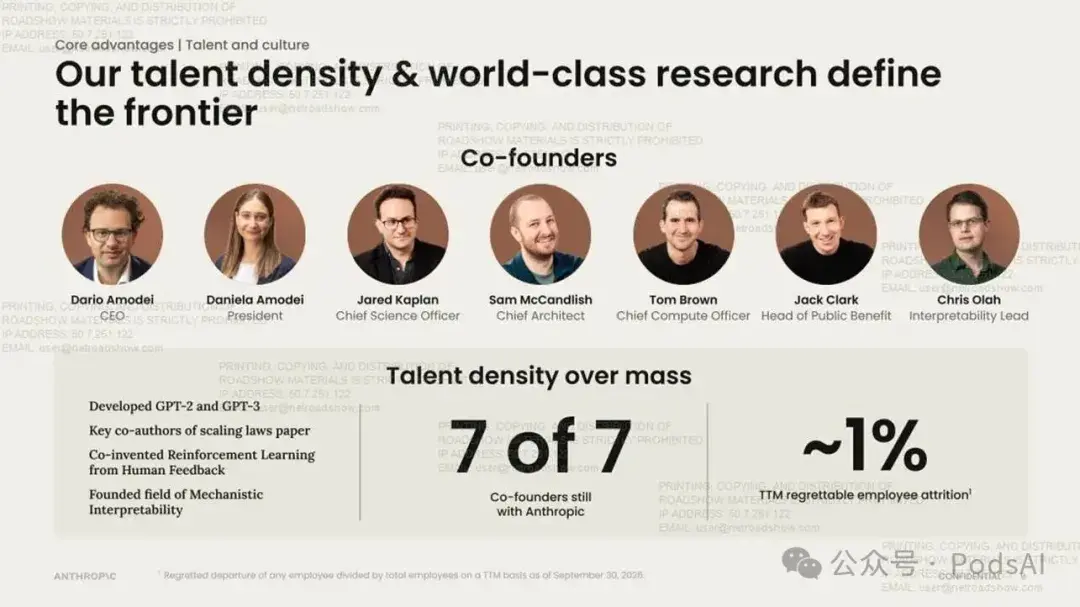
This slide shows the seven co-founders: Dario Amodei, Daniela Amodei, Jared Kaplan, Sam McCandlish, Tom Brown, Jack Clark and Chris Olah. The lower left sums up their record: they developed GPT-2 and GPT-3, were key co-authors of the scaling laws paper, co-invented reinforcement learning from human feedback (RLHF), and founded the field of mechanistic interpretability. Several of the cornerstones of today's large-model industry carry these names.
The two numbers on the right are more direct. All seven co-founders are still at the company, which is no small thing in an industry where executives move often and poaching offers can run into nine figures. Trailing-twelve-month regrettable attrition is about 1%, meaning that of the people Anthropic did not want to lose, only one in a hundred left.
The video intercuts several employees answering the same question: "Why do I work at Anthropic?" One said their brother died of a brain tumor three years ago at 42, their own age now: "Someone has to carry the weight of getting this right, and I don't want to watch from the sidelines." Another said: "People here ask 'should we do this' before they ask 'can we do this.'"
Research: capability and safety are the same work
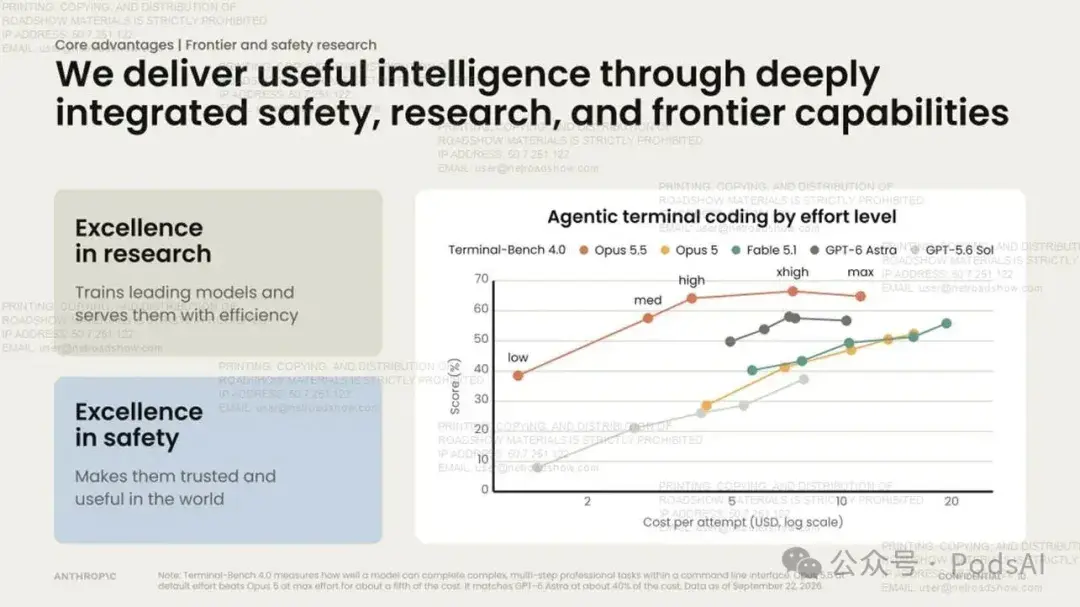
Daniela summed up the research philosophy in one line: "The work of making models safe and reliable is the same work as making them more capable." What the company cares about is "useful intelligence," meaning how well a model handles real tasks and how much value it delivers to customers. The question they keep asking is: what can Claude do for me that other models can't?
This chart backs that up. It compares scores on Terminal-Bench 4.0, an agentic terminal coding test, against cost, with cost per attempt on the horizontal axis (log scale) and score on the vertical. Opus 5.5's curve sits up and to the left at every effort level, meaning it scores higher for the same money. The footnote is more specific: Opus 5.5 at default effort beats Opus 5 at maximum effort for about a fifth of the cost. This comes back again and again in the financial section, because the more efficient the models get, the more room Anthropic has to cut prices without hurting margins.
Chief Science Officer Jared Kaplan picked up the research thread. When the team discovered AI's scaling laws, he said, they realized capabilities could improve very quickly. That is why they founded Anthropic: to make sure that if AI became a transformative technology, it would be safe and beneficial. They evaluate models on capability, efficiency and safety, and aim for models that can accurately plan and complete complex work over hours or even days.
His example: one user migrated 680,000 lines of code in under a day with Opus 5.5, a job that would have taken an engineering team weeks just a few years ago.
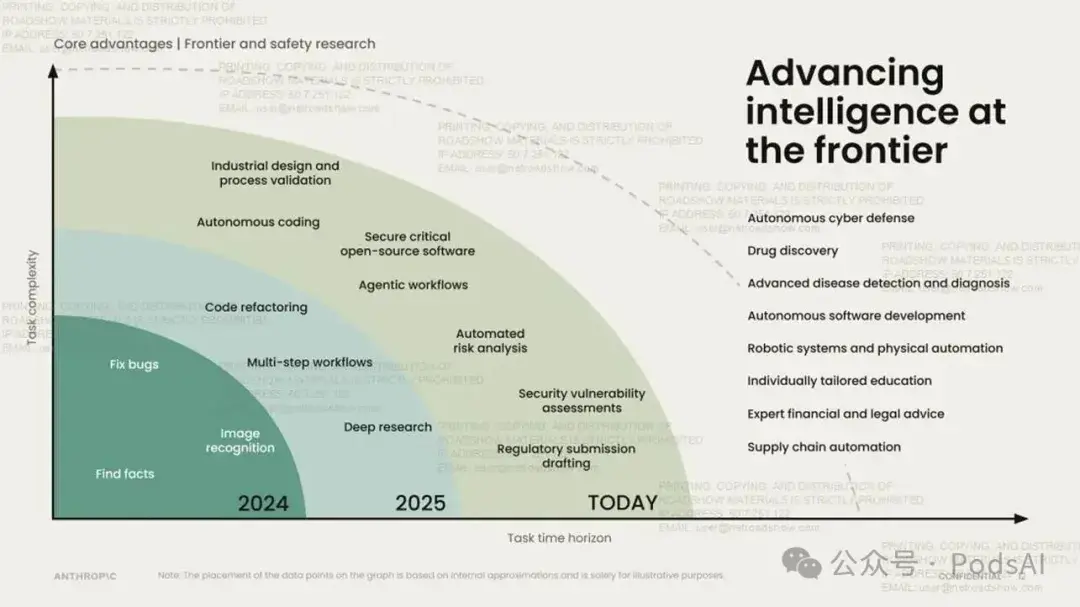
The slide draws capability as arcs pushing outward, with how long a task runs on the horizontal axis and how complex it is on the vertical. The 2024 arc covers finding facts, fixing bugs and recognizing images. By 2025 it reaches code refactoring, multi-step workflows and deep research. Today's arc includes autonomous coding, securing critical open-source software, assessing security vulnerabilities and drafting regulatory submissions. The right side lists what Anthropic sees as the next ring: autonomous cyber defense, drug discovery, advanced disease detection, autonomous software development, robotics, individually tailored education, expert financial and legal advice, and supply chain automation.
Kaplan also briefly explained how models are trained. In pretraining, the model learns from the accumulated body of human knowledge (text, images, scientific papers and code) and picks up humanity's basic concepts. The second stage is reinforcement learning, where Claude learns to be helpful, honest and harmless, and where its practical skills in coding, knowledge work and science are drawn out. As models shift from chat assistants to autonomous agents, RL has become one of the company's biggest research investments. He mentioned that in 2021 he wrote an internal memo predicting that the company's most likely product would be "an aligned AI programmer," which turned out to be quite accurate.
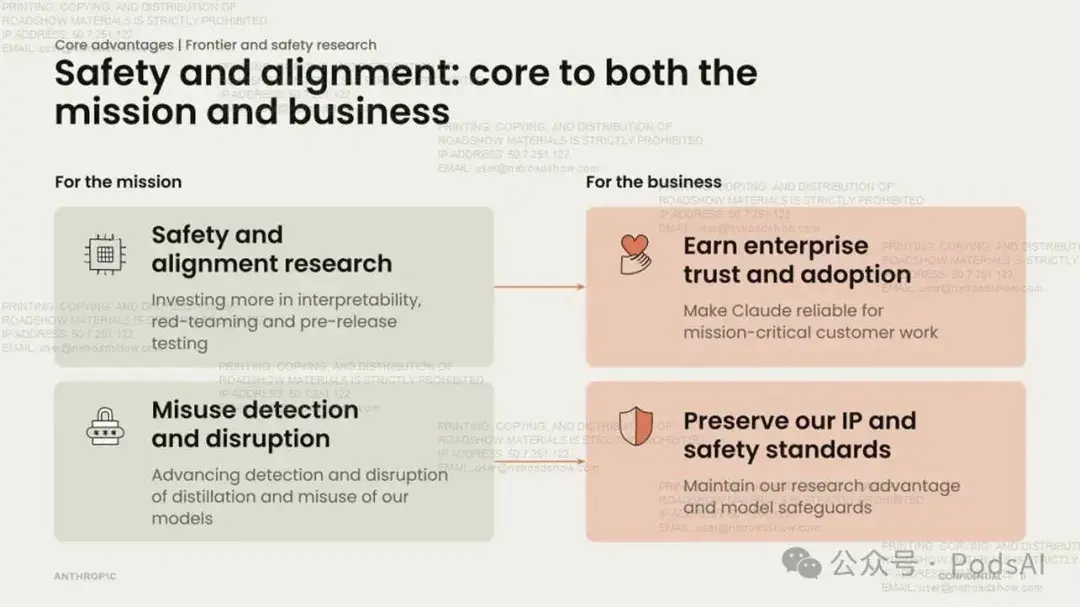
This slide splits safety work into two columns. The left column is "for the mission": investing more in interpretability, red-teaming and pre-release testing, and advancing detection and disruption of distillation and misuse of Anthropic's models. The right column is "for the business": making Claude reliable enough for mission-critical work so enterprises trust and adopt it, and protecting the company's IP and model safeguards.
One detail is easy to miss. Preventing distillation and protecting IP are explicitly on the safety agenda. Distillation means training one model on the outputs of a stronger one, essentially copying its capabilities on the cheap. By putting this alongside misuse prevention, Anthropic shows that in its framework, safety is both an ethical commitment and a competitive moat.
Two loops: models that keep getting better
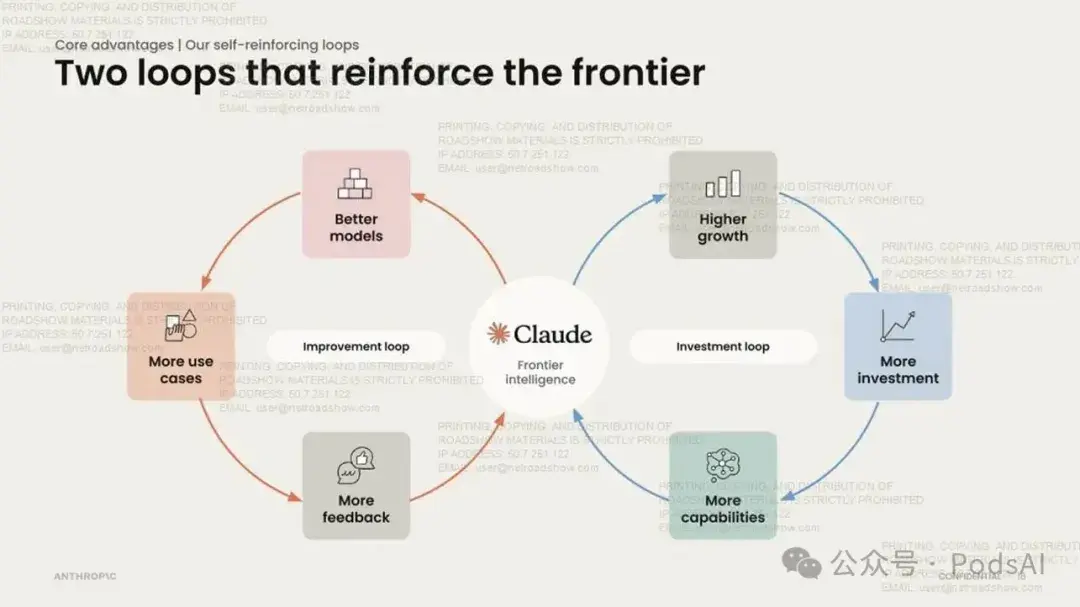
Anthropic explains its growth with two interlocking loops. On the left is the improvement loop: better models lead to more use cases, more use cases bring more feedback, and more feedback trains better models. On the right is the investment loop: more capability drives higher growth, higher growth attracts more investment, and more investment buys more capability. Claude sits at the center of both.
Chief Product Officer Ami Vora later used Claude Code to show how this flywheel turns. As models get stronger, the team builds new features on those gains, then trains the models to better do what people want, which strengthens the whole system.
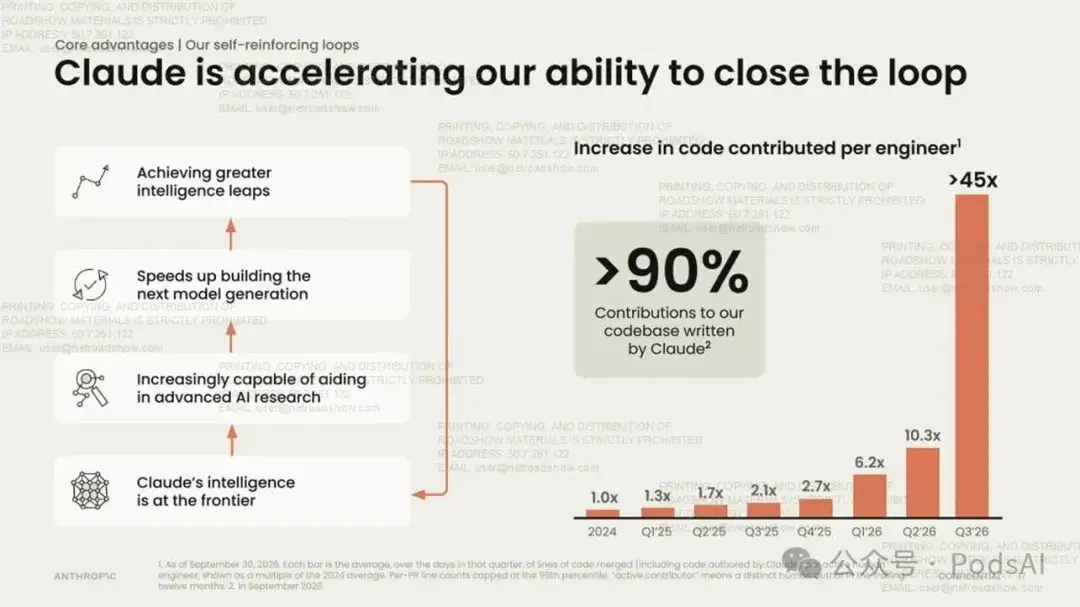
Chief Architect Sam McCandlish pushed this logic one step further with what he called "closing the loop." Inside Anthropic, he said, they increasingly turn frontier models back on their own processes. Claude has become an equal partner. It strengthens the company's security, makes training and inference more efficient, advances safety research, helps researchers try more ideas faster, and makes the whole organization more effective.
The numbers on this slide are striking. More than 90% of contributions to the codebase are written by Claude. Code contributed per engineer, against a 2024 baseline, was 1.3x, 1.7x, 2.1x and 2.7x across the four quarters of 2025, then suddenly accelerated in 2026: 6.2x in Q1, 10.3x in Q2 and more than 45x in Q3. The last two bars are nearly vertical.
McCandlish also explained how safety is built into every stage. Alignment training makes models follow user intent and avoid harmful behavior. Safeguards prevent misuse. Interpretability research shows what is happening inside the model's "brain." His conclusion was that as long as research and safety advance together, they can help bring about some of the biggest breakthroughs in human history.
The narration then recalled a few milestones. In 2025, Claude found a bug in OpenBSD that had gone unnoticed for 27 years. It also built a laser-locking controller for a quantum computing company, a job that used to take a team of PhDs a week, overnight and with no human intervention. The narration ended with: "That exponential is still climbing ahead of us. This is only the beginning."
Compute: doing more with the same dollar
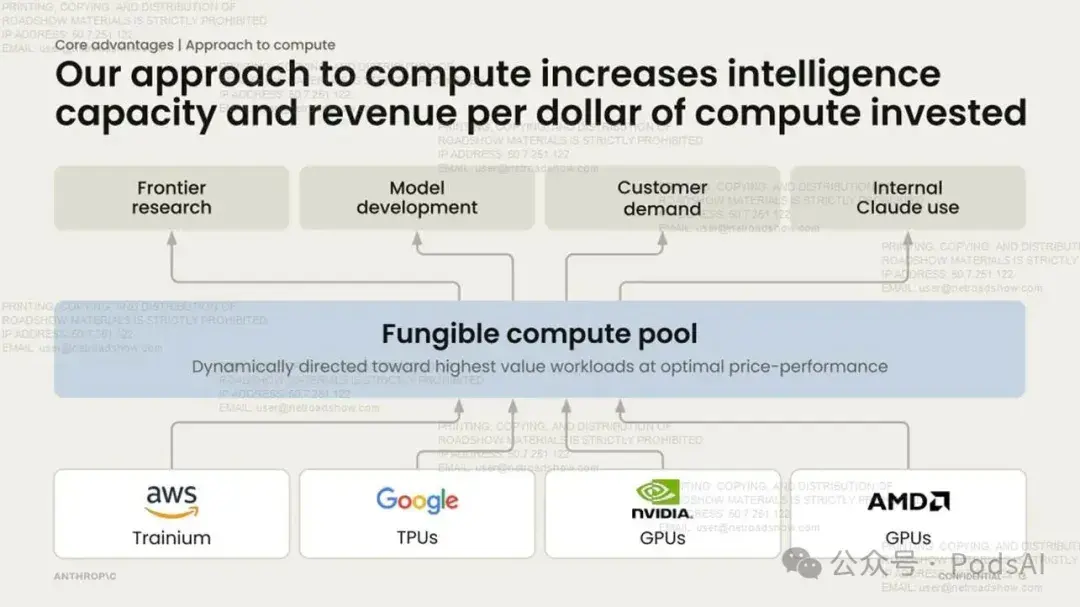
Chief Compute Officer Tom Brown's section is the key to understanding Anthropic's margins. By the time they founded the company in 2021, he said, they already understood two things. First, compute is the foundation of the business. Second, squeezing every bit of value out of each unit of compute is the key to building smarter and smarter models. They believe a dollar of compute goes further at Anthropic than at any other frontier lab, for two reasons.
The first is running on many kinds of chips. Claude trains and serves on Amazon's Trainium, Google's TPUs, NVIDIA's GPUs and AMD's GPUs. Brown called this an unconventional bet made long ago. At the time, many people thought running models on different chips wasn't worth it, because each chip needs its own software and inference stack, which is expensive and hard to build. Anthropic kept at it for years, and now it is very good at it.
That brings two advantages. In a market where compute is scarce, Anthropic can buy whichever chip offers the best price-performance, regardless of vendor. And it can let each chip do what it does best, since some are better for training and others for inference. In the end, every chip across vendors, architectures and locations is treated as one fungible, centrally scheduled pool. It also explains why several chip and cloud companies appear together in the private placement.
Running on many chips has also made Anthropic very good at bringing up new ones. Brown's example was AMD, whose GPUs Anthropic started using for the first time this year. Bringing up a new chip platform used to take dozens of engineers several months. This time they let Mythos try, and it had Claude running on AMD in three days, with almost no human intervention and Claude porting or writing nearly 100% of the kernels.
Anthropic has changed how it handles data centers too. It used to buy compute as a cloud service. Now it has added a second option: leasing chips and running them in data centers designed and built specifically for Anthropic, which it calls Anthropic Direct. That lowers the total cost of ownership and lets the company sign data center commitments separately from chip commitments.
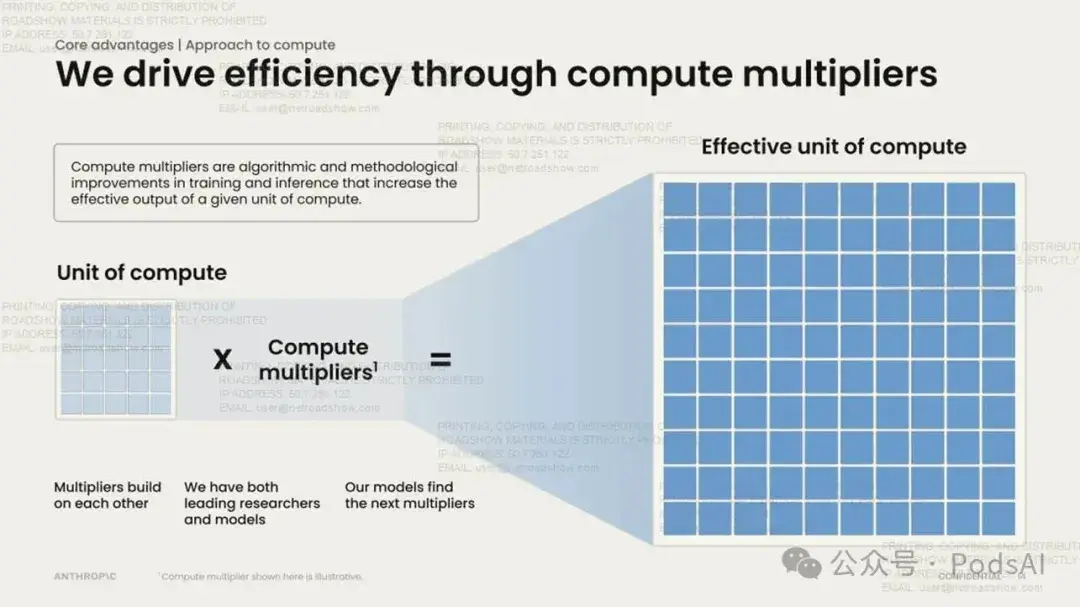
The second reason is compute multipliers. What Anthropic cares about is not how much physical compute it has, but "total effective compute," which is physical compute times the multipliers it has discovered. A compute multiplier is an algorithmic or methodological improvement in training or inference that gets more out of the same unit of compute. Brown gave an example. Suppose training a model at some capability level takes 100 units of compute. A 4x multiplier means you can train exactly the same model with 25 units, or use those 100 units to train a smarter model that would once have taken 400.
Multipliers stack, and each new one makes the earlier ones more effective. Brown said they believe that as the company approaches recursive self-improvement, this effect will speed up further, with Claude able to discover compute multipliers fully on its own so their number grows faster and faster. To investors that sounds like good news. To safety researchers it is worth a second thought.
3. Enterprise adoption of Claude
What enterprises actually care about
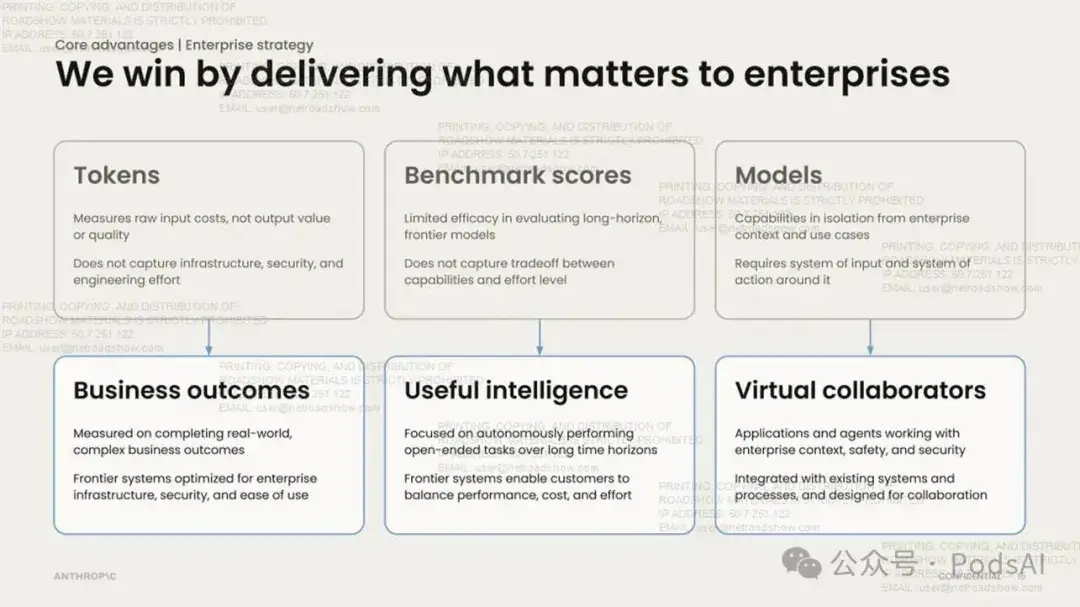
This slide is Anthropic pushing back on how the industry measures itself. The top row shows three common yardsticks, and the bottom row shows what Anthropic thinks enterprises actually care about.
Pricing by tokens measures only input cost. It says nothing about the value or quality of the output, and leaves out infrastructure, security and engineering effort. What enterprises want is business outcomes. Benchmark scores struggle to evaluate long-horizon tasks and don't show the trade-off between capability and effort. Enterprises want "useful intelligence" that can carry out open-ended tasks autonomously over long periods and balance performance, cost and effort. Looking at a model on its own strips away enterprise context and use cases. Enterprises want "virtual collaborators" that are built into existing systems and processes, come with security controls and are designed for collaboration.
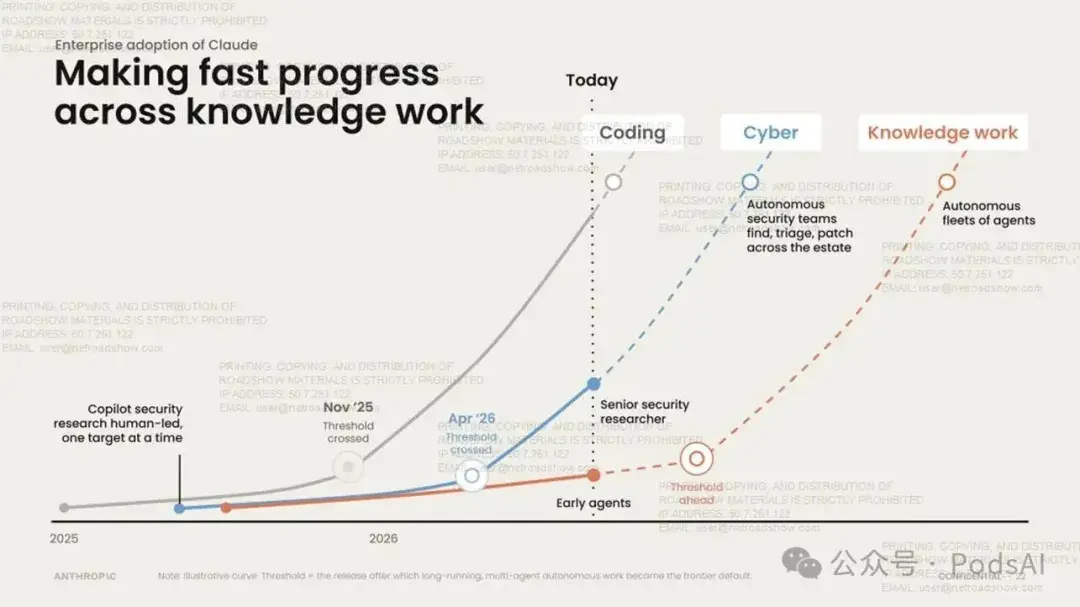
Chief Commercial Officer Paul Smith then made a core argument: AI capability does not improve gradually. Once a model crosses a certain threshold, there is a step change, and a whole category of work changes with it. The slide draws three curves (coding, cybersecurity and knowledge work), each marked with the point where it crossed the threshold.
Coding crossed first, in November 2025. In just one year, Smith said, coding went from autocompleting a few lines to teams of agents working around the clock. For a company like Rakuten, that means shipping new features four to five times faster than competitors.
Cybersecurity crossed in April 2026. The labels on the slide trace how the curve develops. It starts with copilot-style security research that is human-led and one target at a time, passes through the level of a senior security researcher, and ends with autonomous security teams that find, triage and patch vulnerabilities across an entire estate. Smith's example was Mozilla. With Mythos and Project Glasswing, Mozilla went from fixing 20-odd security bugs per release to finding and fixing 271 in a single release with Mythos Preview.
Knowledge work's threshold lies just ahead. The slide marks it "threshold ahead," with autonomous fleets of agents as the end point. Scientific research, investment analysis and insurance underwriting are examples already under way, such as Claude helping AIG cut quote times by 55%. In every area, Smith said, they see the same pattern: first improvement, then a step change, then rapid transformation of a whole category of work.
Product and platform
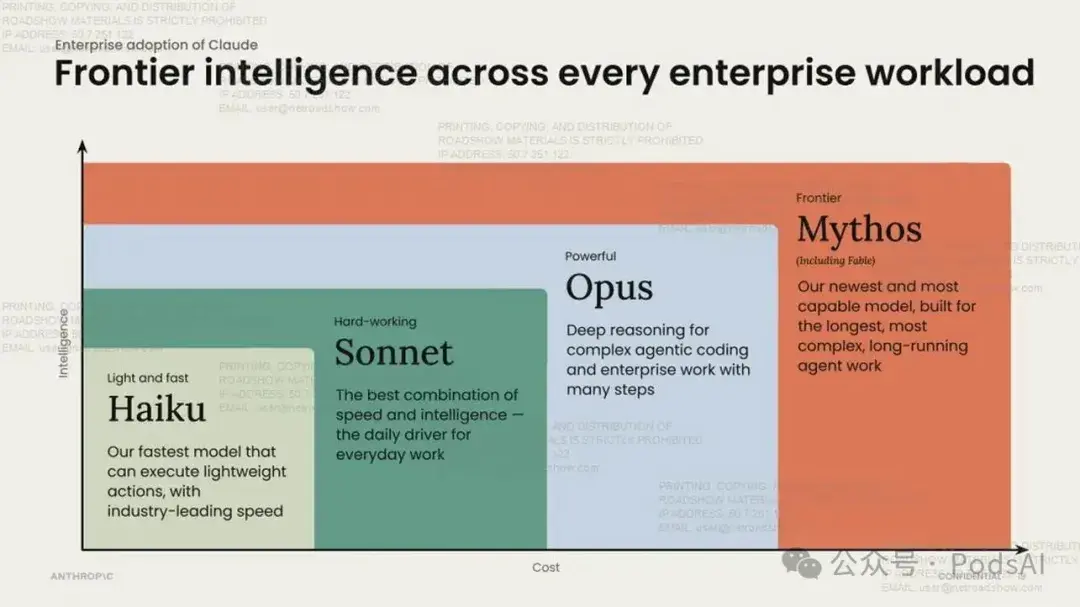
Chief Product Officer Ami Vora began with the model family. The Claude models are designed to deliver value on whatever a customer is optimizing for, whether that is cost, speed or intelligence. Haiku is the fastest, suited to well-defined tasks at large scale. Sonnet balances speed and intelligence and is the everyday workhorse. Opus excels at deep reasoning and complex agentic coding. At the top are Mythos and Fable, for the hardest and longest-running agent work, which customers use to harden cyber infrastructure and make new scientific discoveries.
She then raised a problem. Even as model capability improves exponentially, what most people actually do with models hasn't kept pace. How do you make sure everyone benefits from the whole range of models? Her answer was three product principles.
The first is to meet customers where they are. People can use Claude through Anthropic's own apps, such as Claude Code and the desktop and mobile apps, or inside enterprise applications like Word and Excel. Anthropic also goes deep into individual industries to work out what experts in each field need to get value right away. Lawyers, for example, have the Claude for Legal suite, which connects directly to the tools they use, and there are similar suites for healthcare, financial services and life sciences.
The second is to build models and products in parallel, designing products for tomorrow's models and not just today's. That is how Claude Code was born. A few years ago, the team saw pre-release models getting better at understanding code. They couldn't do everything yet, but the trend line was clear. The team built a product around that bet, and Claude Code shipped a few months later, introducing people to an entirely new way of programming.
The third is to close the gap between frontier capability and everyday use. Most people still treat AI as a search replacement or a simple question-answering tool. Without strong products, Vora said, the gap between growing intelligence and how people actually use it will only widen. The goal is for people to treat Claude like a colleague and get high-quality work every time.
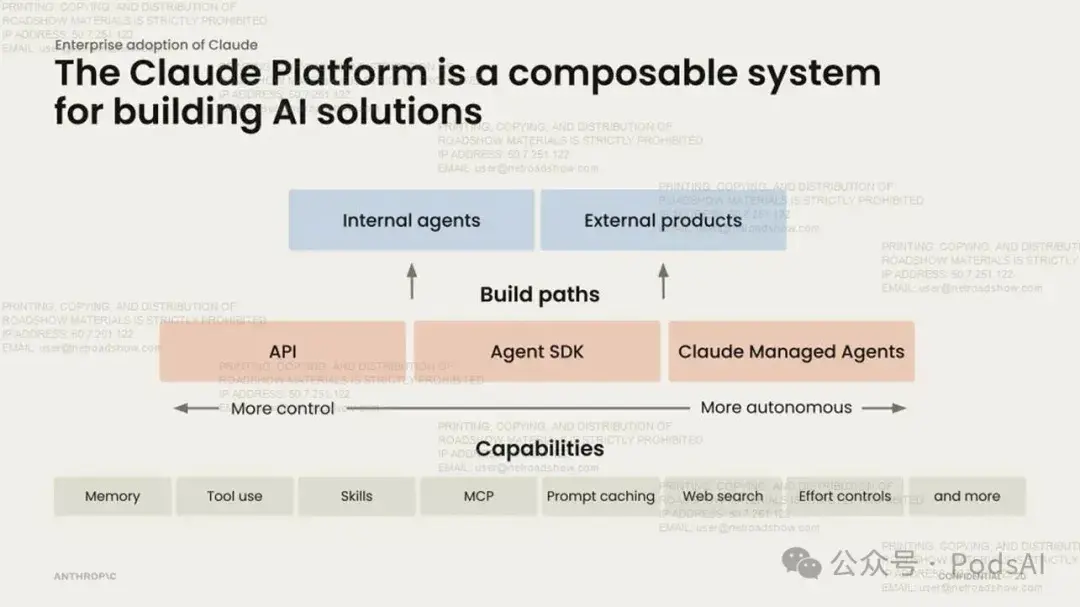
For developers, the Claude Platform offers three build paths. From left to right, they give less control and more autonomy. The API leaves developers fully in charge, the Agent SDK provides a framework for building agents, and Claude Managed Agents has Anthropic host and run the agents. All three share a set of underlying capabilities, including memory, tool use, skills, MCP, prompt caching, web search and effort controls. Enterprises can use them to build agents for internal use or products to sell.
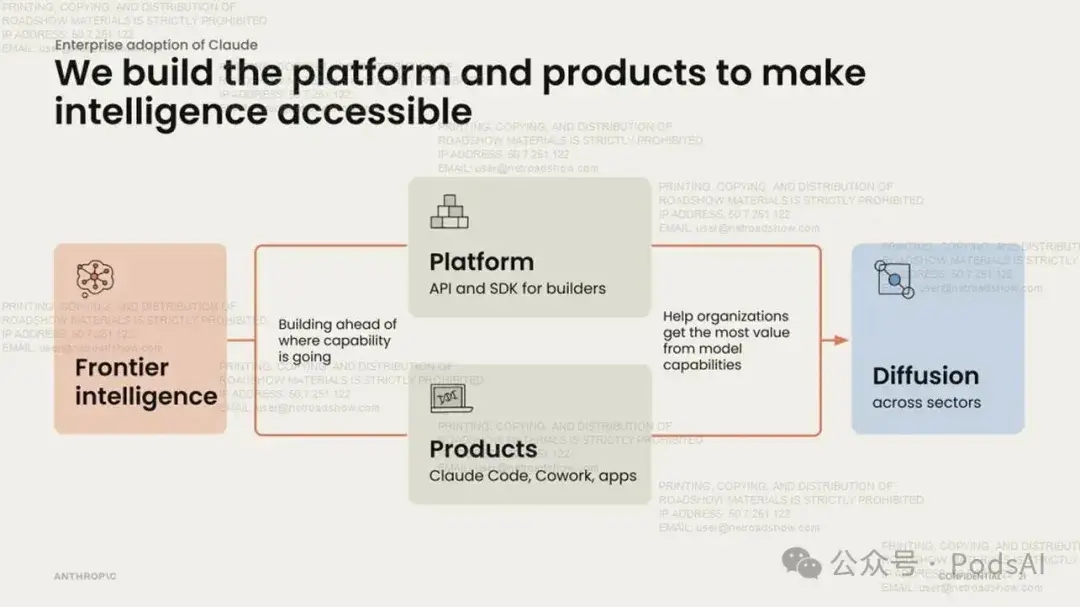
This chart lays out how the platform and products fit together. Frontier intelligence sits on the far left and splits into two paths: the platform for developers, and products (Claude Code, Cowork and the apps) for end users. Both paths lead to "diffusion across sectors" on the right. The platform's role is to build ahead of where capability is going, and the products' role is to help organizations get the most value out of model capabilities.
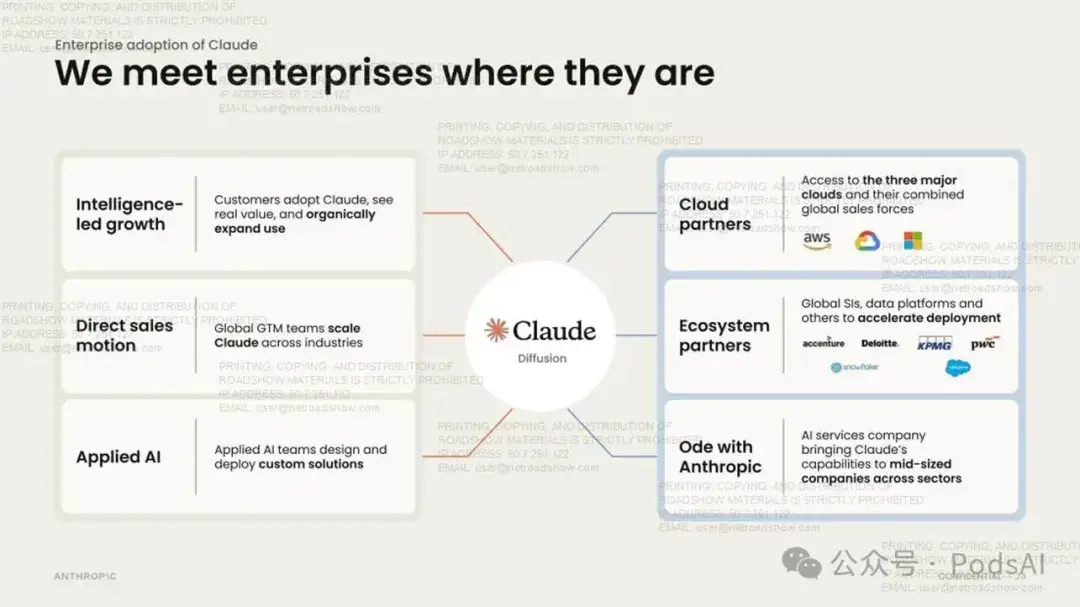
On go-to-market, Anthropic was the first frontier lab available on all three major clouds: AWS, Google Cloud and Microsoft Azure. Enterprises can deploy Claude in the cloud environments they already use and tap the cloud providers' global sales forces, while Anthropic keeps a direct relationship with end customers, including control over pricing. Ecosystem partners include consultancies like Accenture, Deloitte, KPMG and PwC, along with data and software platforms like Snowflake and Salesforce. There is also Ode with Anthropic, an AI services company that brings Claude's capabilities to mid-sized companies across sectors.
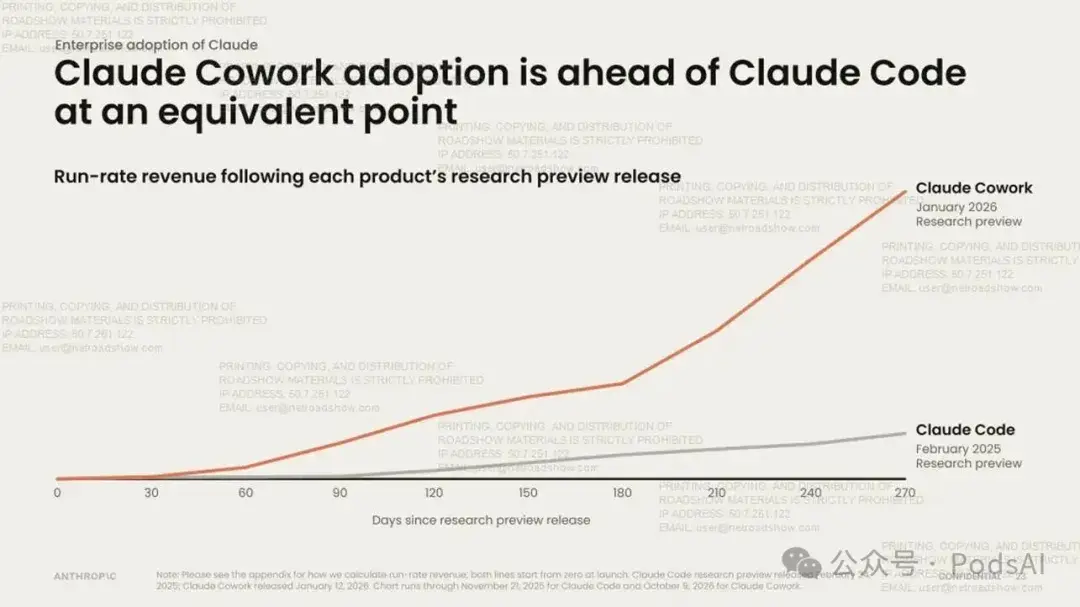
The newest product signal is Claude Cowork. This chart puts the two products on the same starting line, with days since research preview on the horizontal axis and run-rate revenue on the vertical. Claude Code's research preview launched in February 2025 and Cowork's in January 2026. At the same number of days, Cowork's curve is clearly steeper. Claude Code is already one of Anthropic's most important growth engines, and the message here is that Cowork is growing even faster than Claude Code did.
Three pillars of customer value
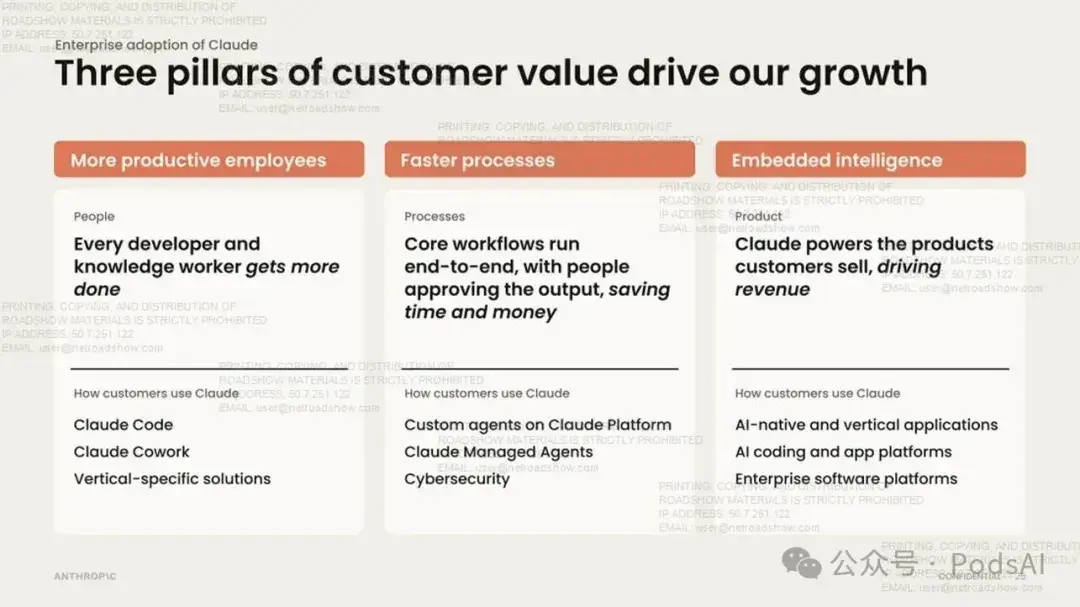
Anthropic sorts the value customers get from Claude into three pillars, each going deeper into the business than the last.
The first is more productive employees: every developer and knowledge worker gets more done, mainly through Claude Code, Claude Cowork and industry solutions. The second is faster processes: core workflows run end to end, with people approving the output, saving time and money, mainly through custom agents on the Claude Platform, Claude Managed Agents and cybersecurity. The third is embedded intelligence: Claude powers the products customers sell to their own customers, driving revenue directly, mainly through AI-native apps, AI coding platforms and enterprise software platforms.
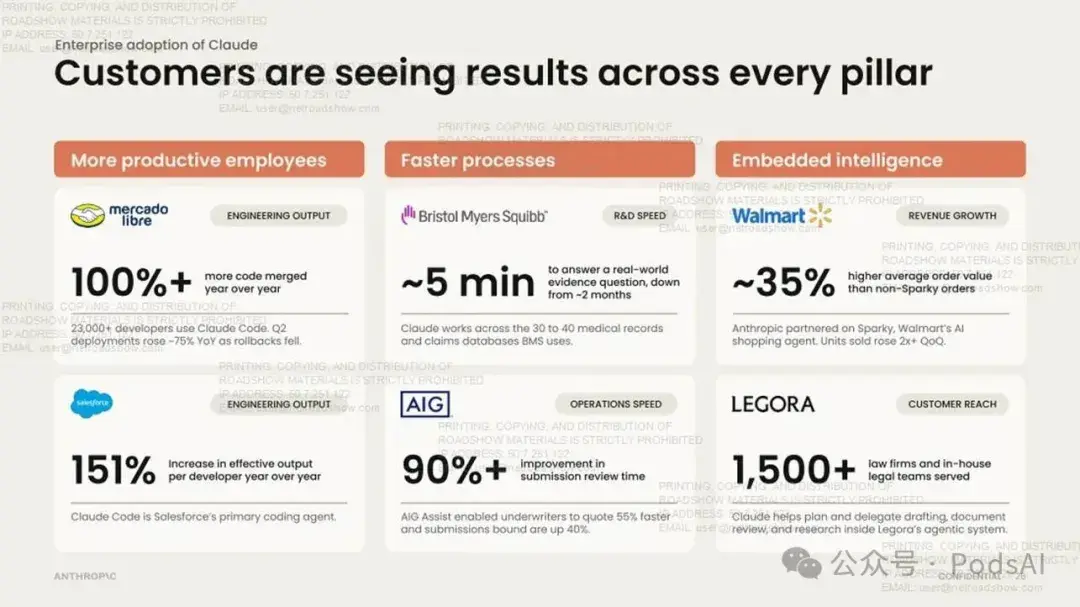
The slide gives two customer examples for each pillar:
| Customer | Area | Result |
|---|---|---|
| Mercado Libre | Engineering output | 23,000+ developers use Claude Code; merged code up more than 100% year over year; Q2 deployments up ~75% year over year as rollbacks fell |
| Salesforce | Engineering output | Effective output per developer up 151% year over year; Claude Code is Salesforce's primary coding agent |
| Bristol Myers Squibb | R&D speed | A real-world evidence question went from ~2 months to ~5 minutes; Claude works across the 30 to 40 medical records and claims databases BMS uses |
| AIG | Operations speed | Submission review time improved 90%+; underwriters quote 55% faster, and bound submissions are up 40% |
| Walmart | Revenue growth | Orders through Sparky, Walmart's AI shopping agent built with Anthropic, have ~35% higher average order value; units sold more than doubled quarter over quarter |
| Legora | Customer reach | Serves 1,500+ law firms and in-house legal teams; Claude plans and delegates drafting, document review and research in Legora's agentic system |
Executives from three of these customers spoke in the video, and what they said reveals more about what enterprises care about than the numbers on the slide.
Greg Meyers of Bristol Myers Squibb began with why BMS is betting heavily on AI. They believe AI can cut the time to run a clinical trial by 20–30%. If a drug reaches market two or three years earlier, patients who have no treatment today get one sooner, which is a huge win for patients and for the company. As for why Anthropic, one reason, he said, is that its enterprise capabilities are the most mature: "Having a chatbot that works is one thing. Actually putting it into an environment where it can access some of the company's most confidential information, while giving you observability, security management and fine-grained control over what users can access, is something else entirely. Those are the enterprise controls IT departments really care about."
BMS rolled Claude out to all 30,000 employees, and Meyers said it was the fastest rollout and best adoption of any AI tool the company has deployed. Now you can ask a very complex question, and Claude works out on its own which database or databases to query, then produces a report with epidemiological context already built in. Answering even a simple question used to take one to two months; now it takes four or five minutes.
Julie Sweet of Accenture said AI is a breakthrough innovation, but you only capture the value it promises by fundamentally reinventing the business. Tens of thousands of Accenture engineers use Claude every day across the software development lifecycle, which frees up time for them to focus on solving clients' hardest problems, leading decisions and setting strategy. Accenture defends thousands of clients against cyberattacks, and it has built Claude Code and the Agent SDK into Cyber.ai, its security platform. Scans that used to take days now finish in under an hour.
AIG President and CEO Eric Andersen said it is hard to overstate how quickly Claude has been embedded inside AIG. It has helped AIG build better underwriters. Claude extracts the information from submissions and puts it in a format underwriters can act on directly, so they decide noticeably faster, handle more submissions more consistently and respond to customers sooner. Andersen also stressed regulation. AIG stays in close contact with regulators about how it uses AI, and human judgment and oversight, which matter a great deal to both AIG and its regulators, are built into the process.
The three executives came at it from different angles, but they had one thing in common. None of them talked only about how smart the model is. They talked about permissions, observability, regulation and human oversight. Those are the hurdles an enterprise has to clear before it puts AI into its core business.
Penetration is still early
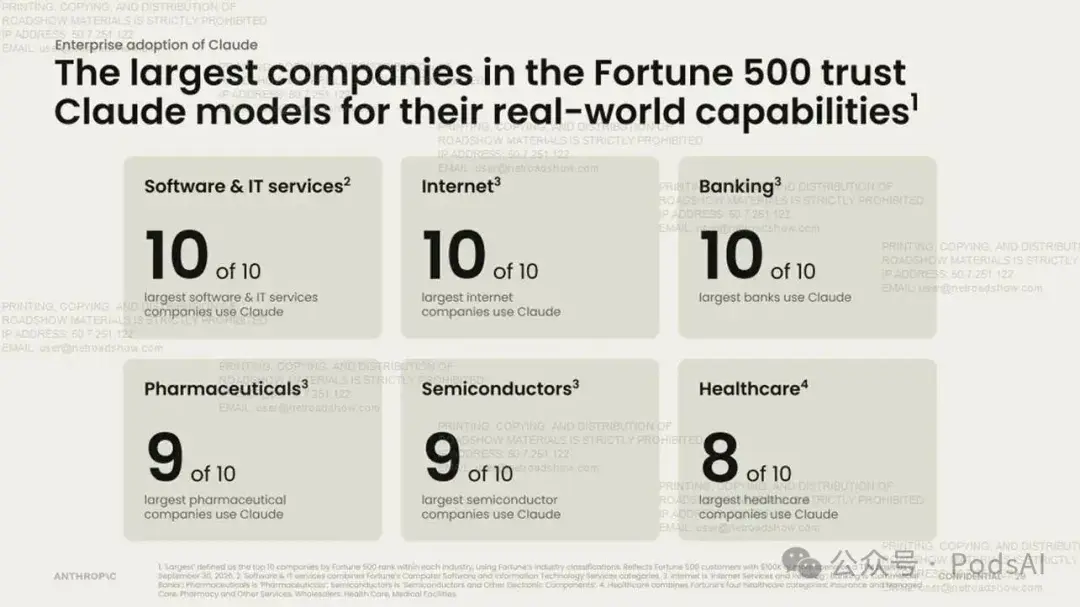
Paul Smith then laid out Anthropic's reach among large companies. Taking the 10 largest Fortune 500 companies in each sector: in software and IT services, internet, and banking, all 10 use Claude. In pharmaceuticals and semiconductors, 9 do. In healthcare, 8 do. Anthropic works with every company in the Fortune 10.
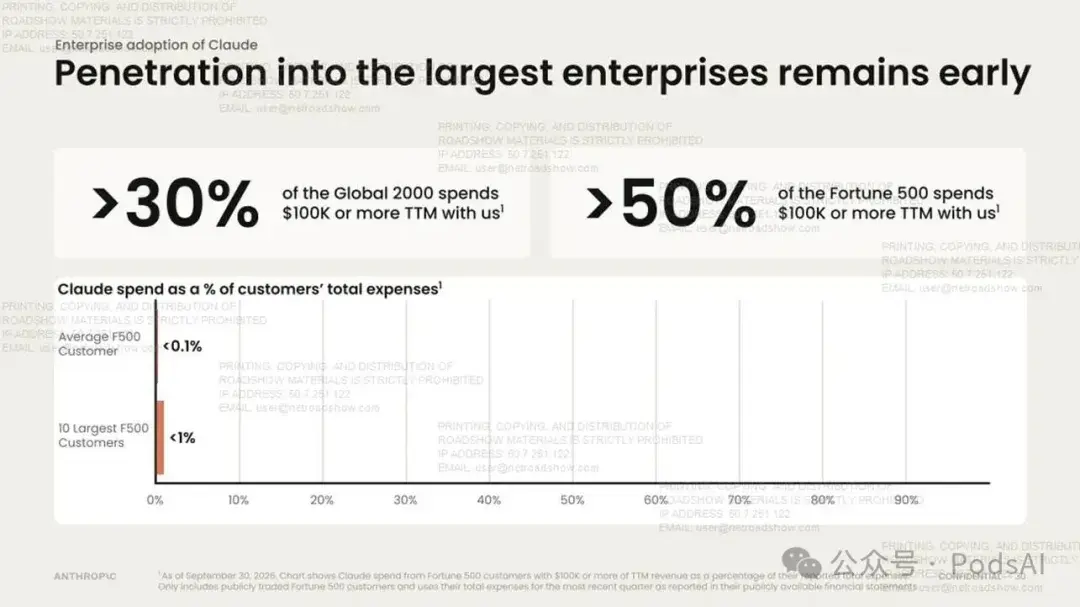
The reach is broad, but the spending is still shallow. More than 50% of the Fortune 500 and more than 30% of the Global 2000 spend over $100K a year with Anthropic. Yet those Fortune 500 customers spend on average less than 0.1% of their total expenses on Claude, and even the 10 largest customers spend less than 1%. Smith's reading is that this is still early in a transformation that will run for decades. The chart's horizontal axis runs all the way to 90% and is almost entirely empty, which is the visual way of saying there is plenty of room left.
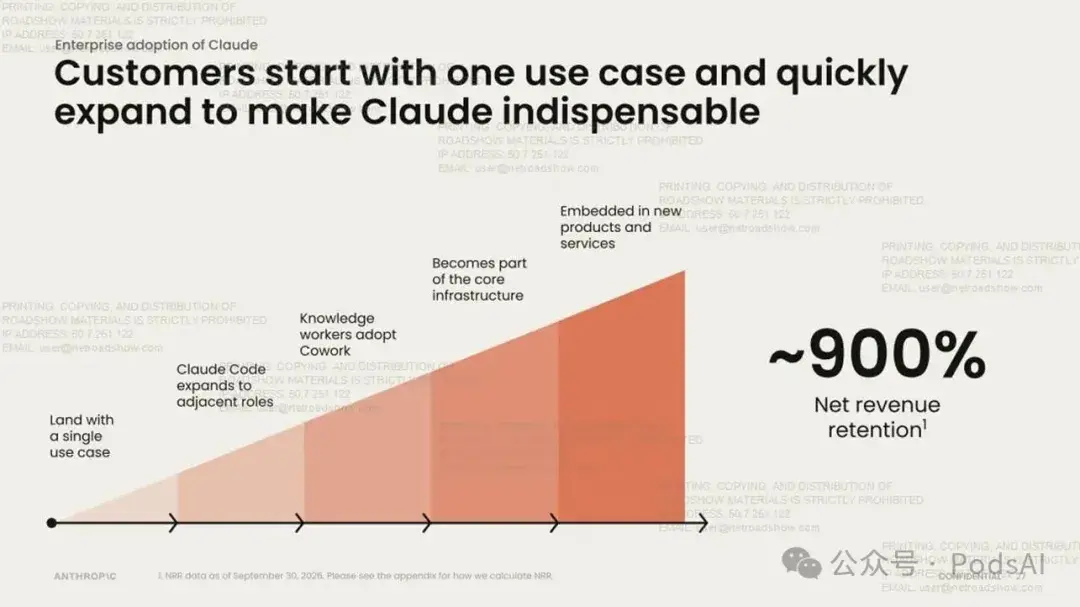
So how do customers go from using a little to using a lot? Smith described a typical customer journey. It usually starts with one use case, often developers and engineers using Claude Code, and quickly spreads to adjacent roles. Next, knowledge workers start using Claude for their highest-value work. Then teams automate more business processes and build AI into core infrastructure. Finally, the customer embeds Claude in entirely new products and services.
Because this happens fast, Anthropic's net revenue retention is about 900%, meaning existing customers spend on average nine times what they spent a year earlier. For comparison, enterprise software companies typically run net revenue retention of 110% to 130%, and 150% counts as exceptional. 900% is a figure with almost no precedent.
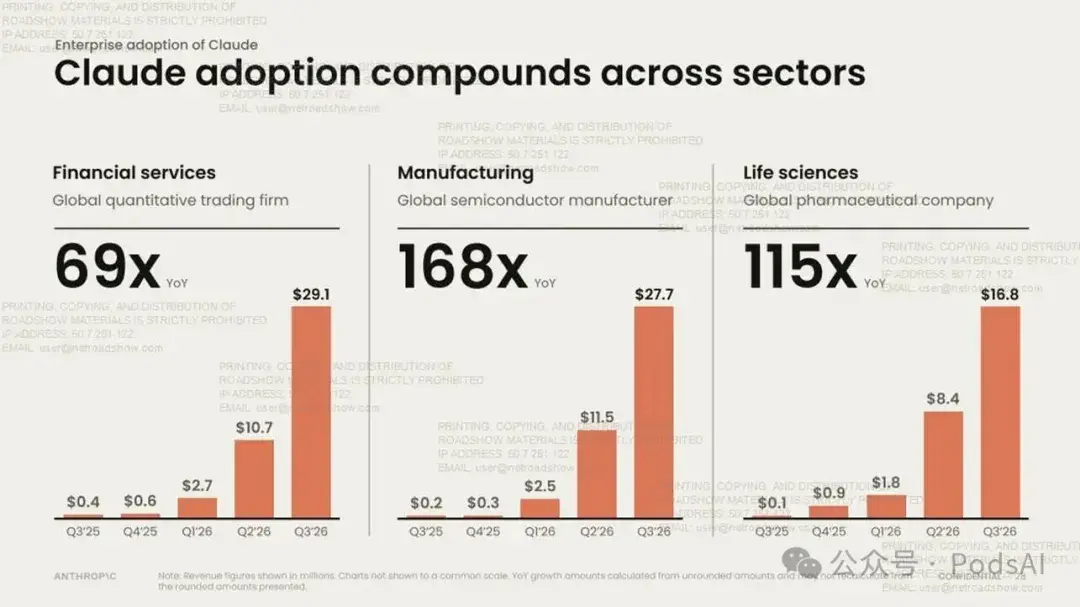
This slide shows the expansion through a representative customer in each of three sectors. A global quantitative trading firm grew its Claude spend 69x year over year, a global semiconductor manufacturer 168x, and a global pharmaceutical company 115x. The three bar charts look almost identical: flat for the first several quarters, then shooting up in the last two or three.
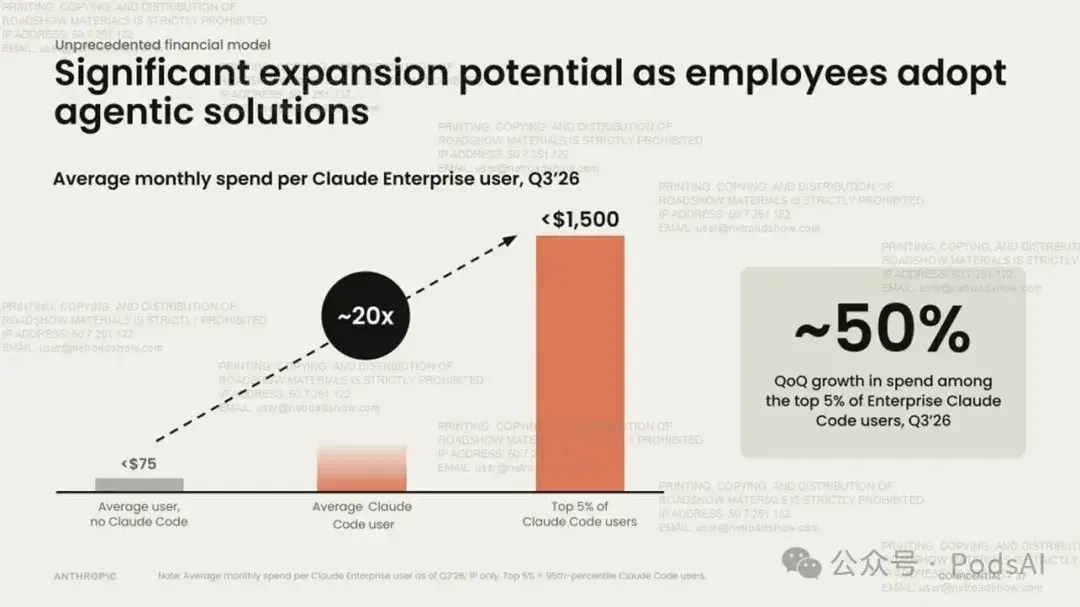
Looked at per user, there is just as much room to grow. A typical Claude Enterprise user who doesn't use Claude Code spends about $75 a month, while the heaviest 5% of Claude Code users spend about $1,500 a month, roughly 20 times as much. Spending by that top 5% also grew about 50% quarter over quarter in Q3. The implication is that as more employees adopt agentic tools, spending per enterprise could rise by another order of magnitude.
Beyond the lab
A narrated segment in the video covers several times Claude left the office and went into the real world.
In December 2025, Claude helped plan a drive for the Perseverance rover on Mars. It wrote code in the rover's own markup language, engineers checked every command before it was sent, and the rover drove 400 meters to complete the task. In summer 2026, about 950 Claude agents screened 1.9 billion protein clusters in 21 hours. One of them spotted an unusual pattern: a system with a CRISPR-like repeat array. Anthropic's scientists validated it in the lab. It had never been published before, a genuine new discovery. In September 2026, teams responding to the Ebola outbreak in eastern Congo used Claude to process every region's daily reports within an hour, giving them a clearer picture of the outbreak and more time to care for patients.
The narration went on to say that the power to affect the real world makes safety matter more. That is why Claude's full biology capabilities are available only to vetted institutions, why Claude has a "constitution" that lets it make judgments in situations it has never seen, and why the company invests so heavily in interpretability and alignment so that Claude stays accountable wherever people rely on it. The narration's conclusion: "Time and again, we've found that safety hasn't held us back. Quite the opposite: because we can trust Claude's work, we can bring its discoveries into the real world."
4. The financial model
CFO Krishna Rao had the longest section, and the most numbers. He opened by saying that AI's transformation of the global economy is the biggest economic opportunity in history, and Anthropic is uniquely placed to capture it. The company leads at the frontier, and it expects value to concentrate disproportionately at the frontier.
Overview: growth and profits at the same time
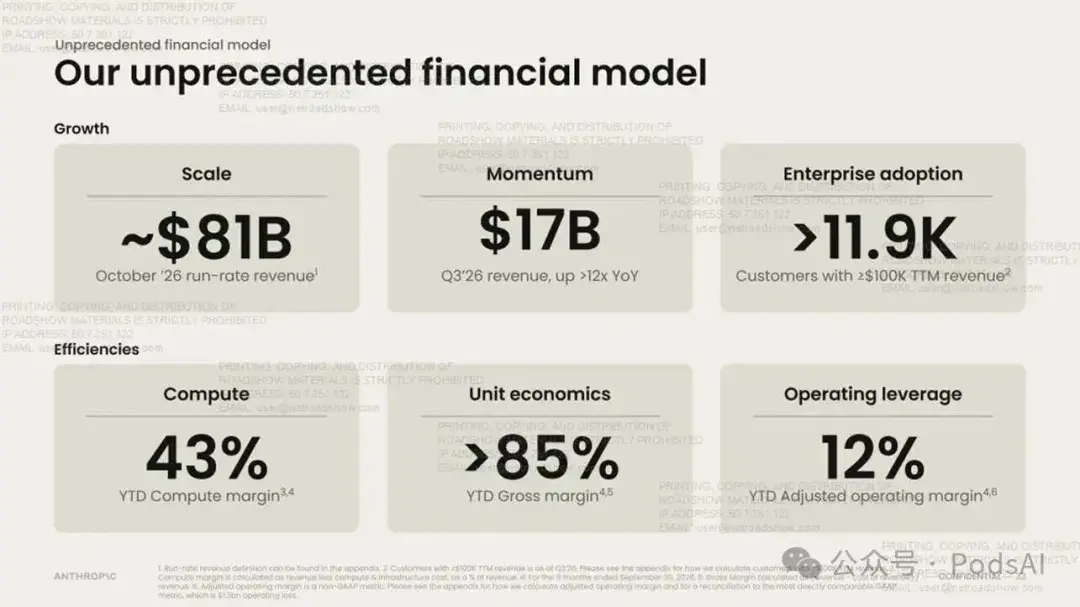
This slide compresses Anthropic's financial position into six numbers. The top row is about growth: October run-rate revenue of about $81B, Q3 revenue of $17B (up about 12x year over year), and more than 11,900 customers spending over $100K a year. The bottom row is about efficiency: a 43% compute margin, 85%+ gross margin and 12% adjusted operating margin, all year to date.
Rao stressed one point in particular: the company is already free-cash-flow positive. A company whose revenue grows 12x in a year usually burns heavily to buy that growth. Anthropic wants to show that its growth pays for itself. Still, he said, despite strong profitability, the company remains in an active investment phase, focused on building a business that runs deep and lasts.
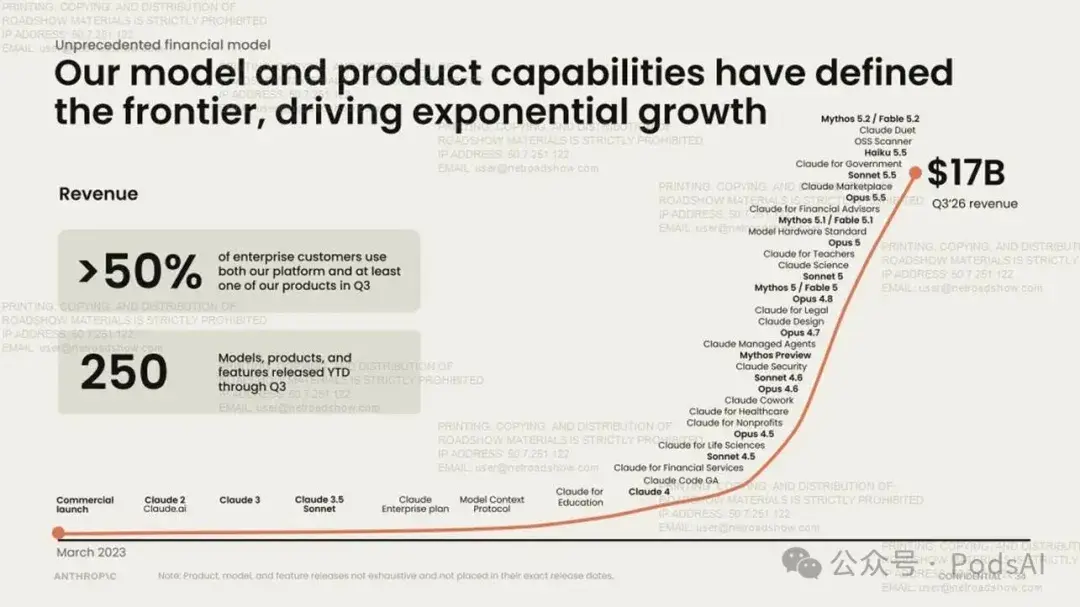
This revenue curve is packed with model and product launches, from commercial launch in March 2023 through Claude 2, Claude 3, Claude 3.5 Sonnet and MCP, to the near-weekly releases after Claude 4. The curve steepens sharply after Claude 4. Rao's point is that revenue follows model capability.
Five differentiators
Rao summed up Anthropic's business model as five differentiators, which form the backbone of the whole financial section.
The first is "model-driven growth." Anthropic builds models that deliver the most useful intelligence, and as it pushes the frontier forward, customers find more valuable work for Claude and revenue follows. Quarterly revenue grew from $376M in Q1 2025 to nearly $17B in Q3 2026, driven by large gains in the models' abilities in coding, agentic workflows and real-world tasks.
Rao added a point that is easy to overlook: smarter models are also more efficient. They can finish tasks at lower effort levels and use fewer tokens. Frontier intelligence also gets passed down from large models to smaller ones, covering the full range of cost, capability and speed. He noted that the recently released Claude 5 family is a big step up in capability from the Claude 4 family released a few months earlier, yet much cheaper per task. That lets Anthropic offer the most capable model at any given cost and move toward the Pareto frontier on most customer workloads.
The second is a leading platform and products. The platform is the foundation of the business, and customers have enormous room to build products and rework processes on the API and SDKs. Anthropic's own products are a key engine of adoption. Rao called Claude Code essentially a bet on the exponential progress of models. Putting it in customers' hands let Anthropic capture the upside as agentic coding abilities surged, and it is running the same play with Cowork. In Q3, more than 50% of enterprise customers used both the platform and at least one product, up from 30% in Q4 2025.
Product velocity is accelerating too. Anthropic shipped 250 models, products and features in the first nine months of 2026, and employee use of Claude across the company grew more than 250x over the same period. Together these drove revenue per employee from $1.4M in Q3 2025 to more than $6.6M in Q3 2026, an increase of more than 4.5x.
The third is compute efficiency, which gets its own section below.
The fourth is a sustained focus on enterprises. Anthropic decided early that enterprises would be AI's biggest and best customers, and has focused on that market since its commercial launch in Q1 2023.
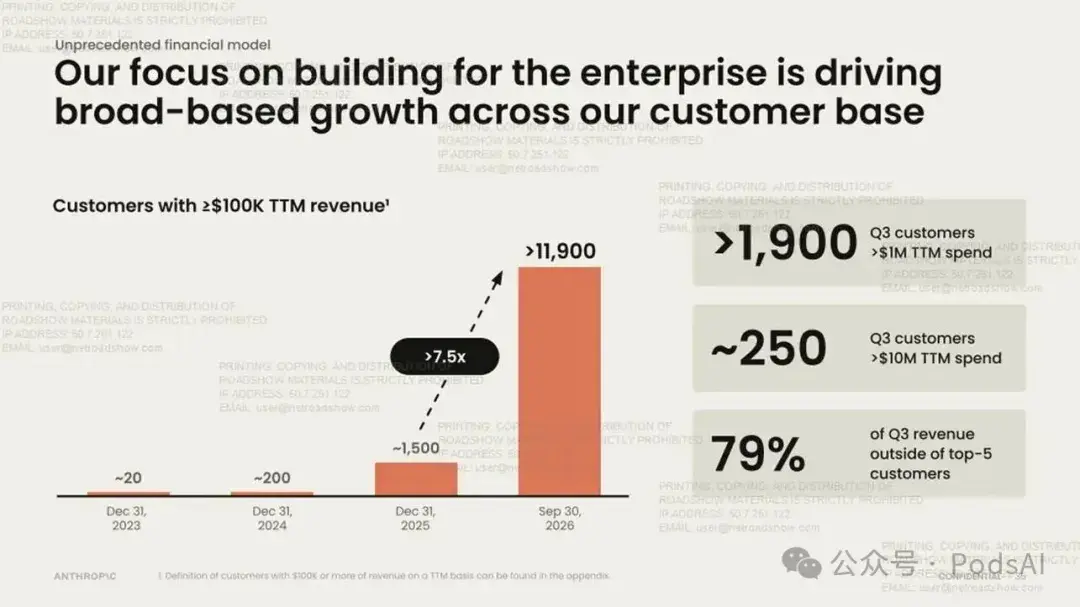
The number of customers spending over $100K a year was about 20 at the end of 2023, about 200 at the end of 2024 and about 1,500 at the end of 2025, and passed 11,900 by September 30, 2026, more than 7.5x growth this year alone. The three numbers on the right show this growth doesn't rest on a few big accounts. About 1,900 customers spend over $1M a year, about 250 spend over $10M, and 79% of Q3 revenue came from outside the top five customers.
Rao also said that being the first frontier lab on all three major clouds makes Anthropic's go-to-market far more efficient than its peers'. He offered a comparison: the company's total non-compute expenses, including sales and marketing, people, G&A and other operating costs, are a smaller share of revenue than the median enterprise software company spends on sales and marketing alone.
The fifth is an expanding market. Every company in every industry, Rao said, will be transformed by powerful AI. That process started with coding and is spreading into knowledge work, a $40 trillion market that has barely been tapped. As the frontier keeps advancing, it will open entirely new lines of business.
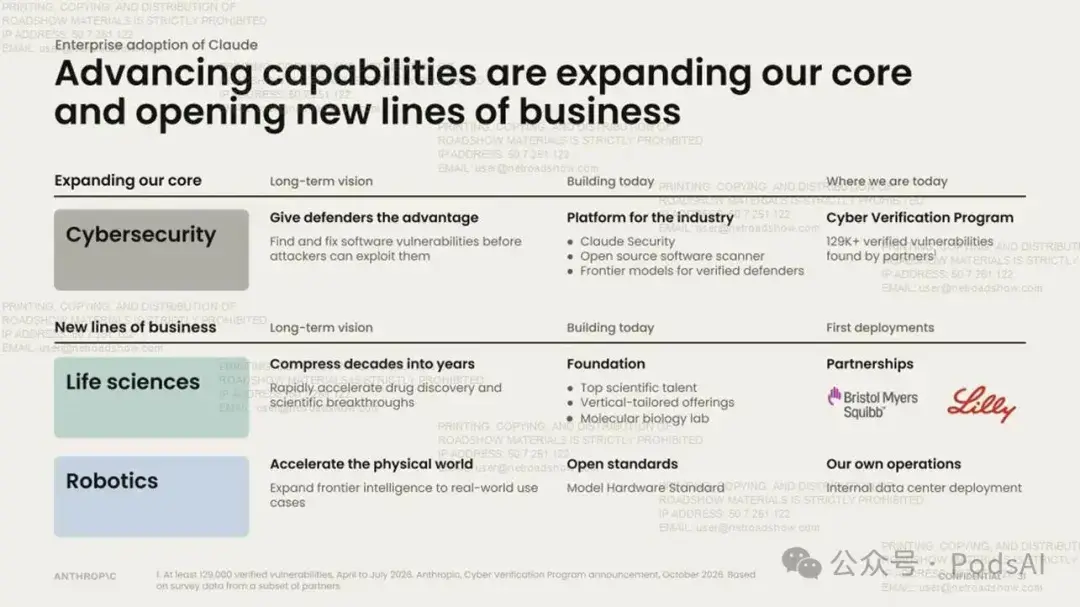
This slide lists three new business lines, each with a long-term vision, what is being built today and where things stand:
| Area | Long-term vision | Building today | Where things stand |
|---|---|---|---|
| Cybersecurity | Give defenders the advantage: find and fix software vulnerabilities before attackers can exploit them | Claude Security, an open-source software scanner, frontier models for verified defenders | Partners in the Cyber Verification Program have found 129K+ verified vulnerabilities |
| Life sciences | Compress decades into years by accelerating drug discovery and scientific breakthroughs | Top scientific talent, vertical offerings, a molecular biology lab | Partnerships with Bristol Myers Squibb and Eli Lilly |
| Robotics | Accelerate the physical world by extending frontier intelligence to real-world use cases | Open standards (Model Hardware Standard) | Deployment inside Anthropic's own data centers |
Cybersecurity is listed first, and it is the only one framed as "expanding our core" rather than a new line of business. The 129,000 verified vulnerabilities is the number in the whole deck most directly relevant to the security industry.
Compute efficiency: the most important chart
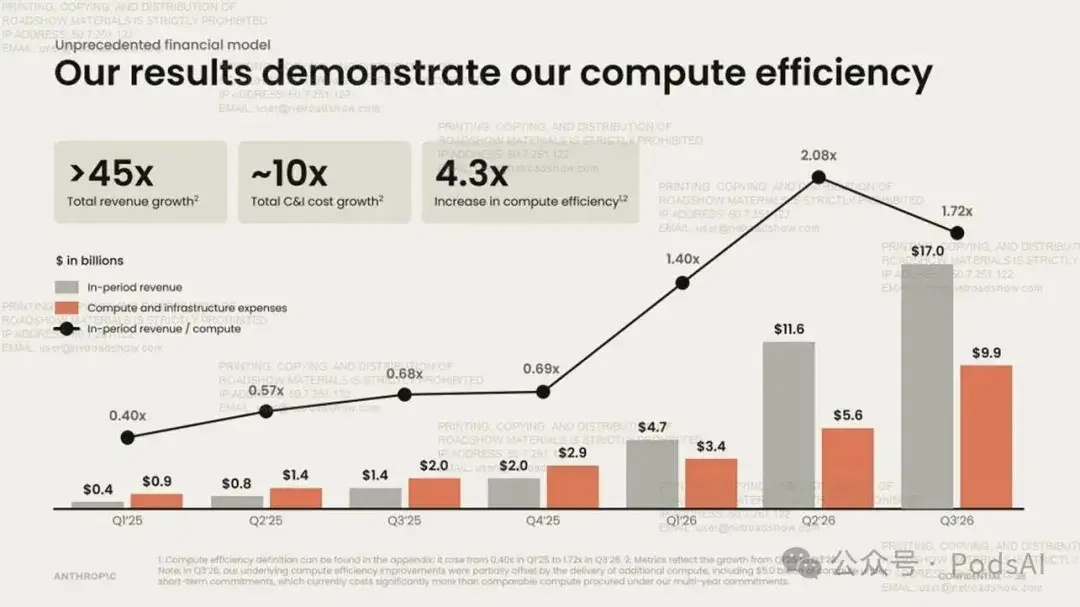
If you could look at only one chart from the whole roadshow, we would pick this one. The gray bars are quarterly revenue, the orange bars are spending on compute and infrastructure, and the black line is the ratio between them, meaning how much revenue each dollar of compute brings in.
In Q1 2025, that ratio was 0.40: every dollar of compute brought in 40 cents of revenue, so the company lost money on every piece of business. It then climbed steadily to 2.08 in Q2 2026 before easing to 1.72 in Q3. Over the past six quarters, revenue grew more than 45x while compute cost grew about 10x, a 4.3x improvement in compute efficiency.
The Q3 dip is worth a note. The footnote explains that underlying efficiency gains in Q3 were partly offset by newly delivered compute, including about $5.0 billion of short-term compute commitments, which currently cost much more than compute under multi-year contracts. In other words, demand grew so fast that the company had to buy compute at short notice and at a premium.
These efficiency gains show up directly in gross margin, which is above 85% year to date compared with 29% a year earlier. Rao said Anthropic treats the gains as capital it can actively allocate: sometimes passing them on to customers through price cuts to drive adoption, and sometimes keeping the margin and reinvesting it in more compute so the advantage keeps compounding.
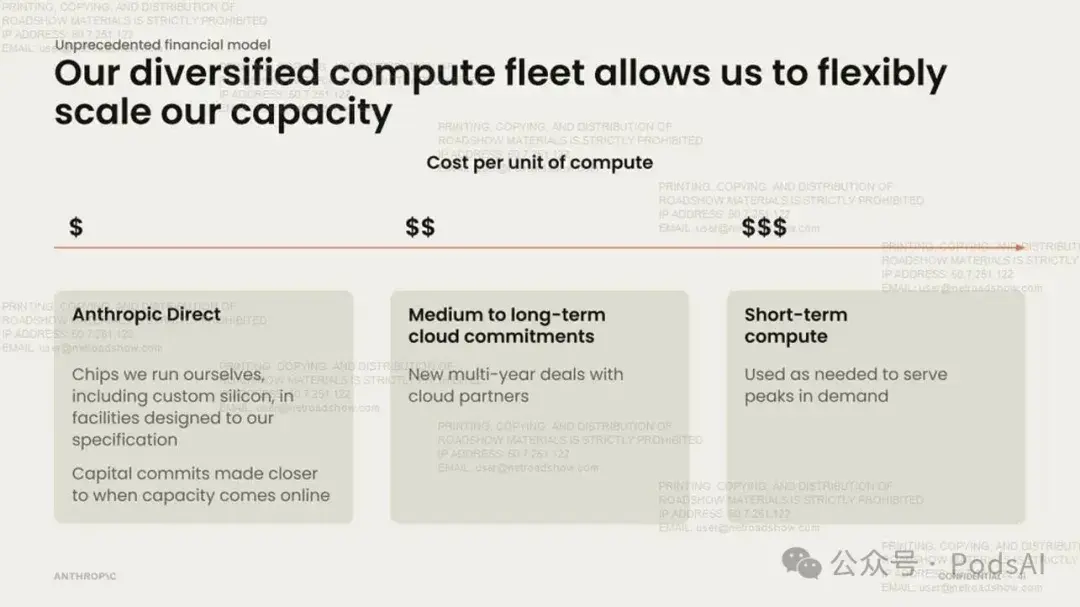
This slide explains where that Q3 dip came from. Anthropic's compute comes in three tiers, ordered from lowest to highest cost per unit. Cheapest is Anthropic Direct: chips the company runs itself, including custom silicon, in facilities built to its own specification, with capital committed close to when capacity comes online. In the middle are medium- to long-term contracts with cloud partners. Most expensive is short-term compute, bought as needed for demand peaks. Rao said he expects Anthropic Direct's share of the compute base to keep rising over the next few years, which is one reason long-term margins can keep improving.
Trading price for growth
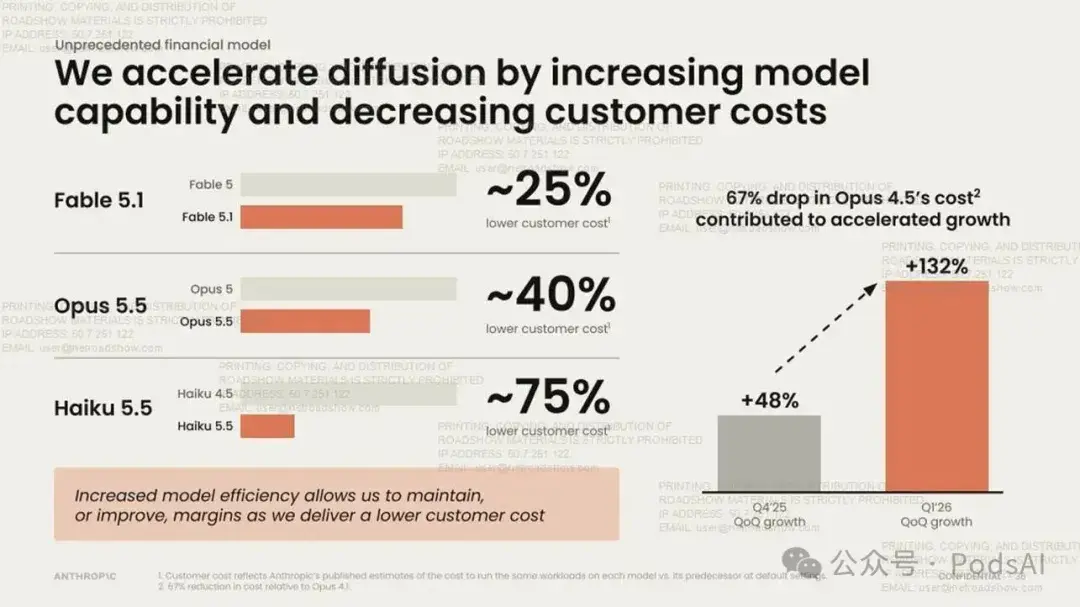
Anthropic's pricing strategy is for model capability to rise while customer cost falls. This slide gives three examples: Fable 5.1 costs customers about 25% less than Fable 5, Opus 5.5 about 40% less than Opus 5, and Haiku 5.5 about 75% less than Haiku 4.5.
Rao went into detail on Opus 5.5. Released in September, it is much more capable and cut customer cost by 40%. He said the cut was margin-neutral because Opus 5.5 is itself much cheaper to serve. Lower prices give up some near-term revenue, but in Anthropic's experience, cheaper intelligence drives broader use and adoption and quickly turns into a revenue tailwind.
The right side of the slide offers the evidence. Opus 4.5 cost 67% less than Opus 4.1, and quarter-over-quarter revenue growth then accelerated from 48% in Q4 2025 to 132% in Q1 2026.
Operating leverage: Claude saves Anthropic money too
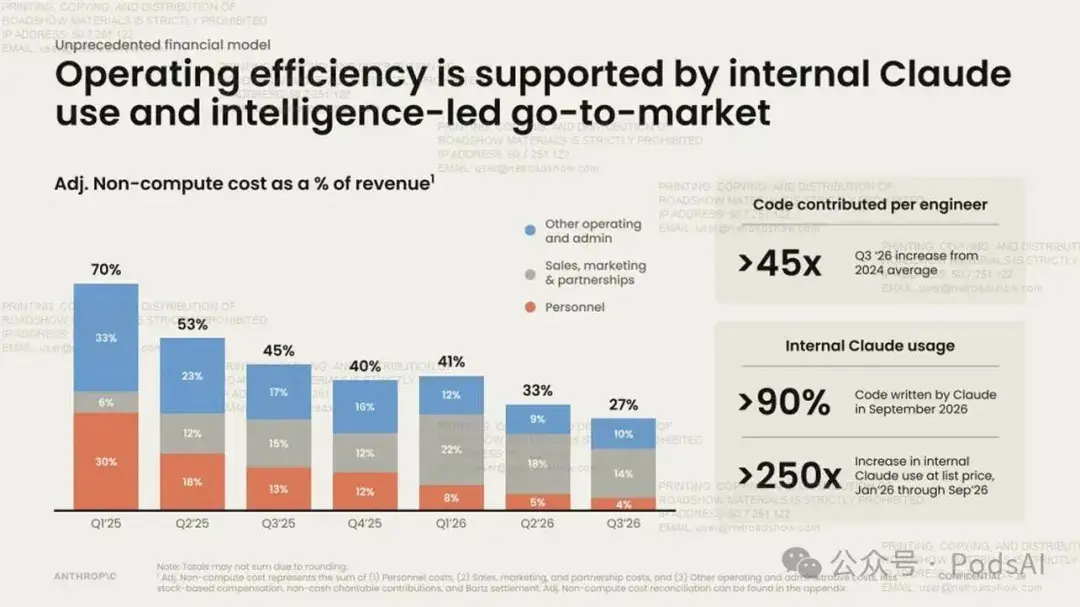
Costs other than compute, including people, sales and marketing, and G&A, fell from 70% of revenue in Q1 2025 to 27% in Q3 2026. The right side of the slide explains why, and the main reason is heavy internal use of Claude. In Q3, code contributed per engineer was more than 45x the 2024 average. In September, more than 90% of code was written by Claude. And from January to September 2026, internal Claude use at list price grew more than 250x.
This is "closing the loop" showing up on the income statement. Claude is not only the product Anthropic sells; it is also how Anthropic keeps its own operating costs down.
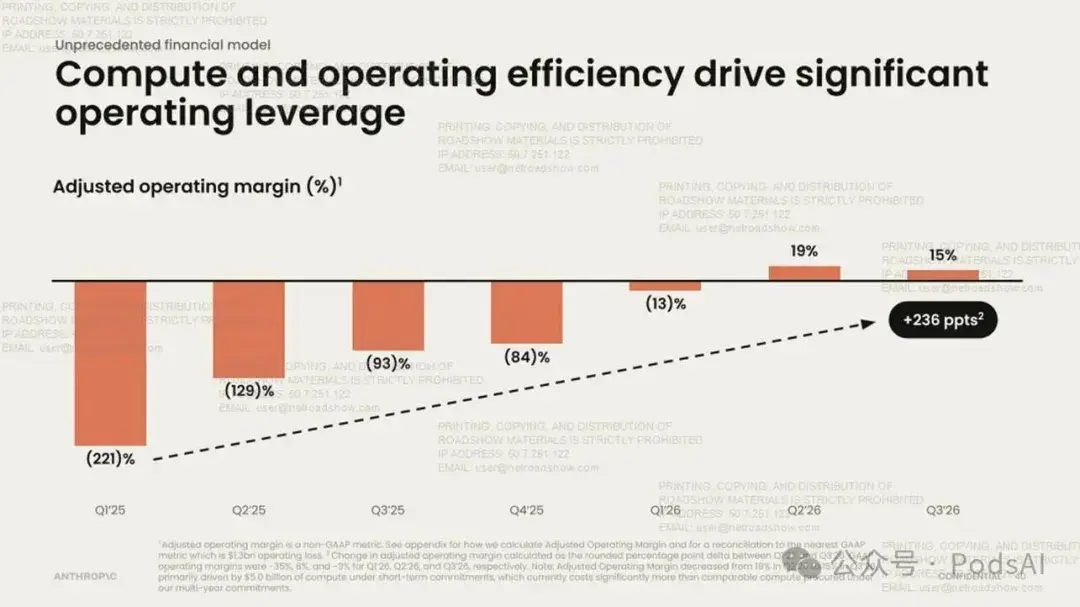
With both cost lines falling, the result is operating leverage. Adjusted operating margin was -221%, -129%, -93% and -84% across the four quarters of 2025, narrowed to -13% in Q1 2026, turned positive at 19% in Q2, and was 15% in Q3, an improvement of 236 percentage points over seven quarters. The footnote again attributes Q3's slight decline from Q2 to that $5.0 billion of expensive short-term compute.
One caution: this is a non-GAAP figure that excludes items such as stock-based compensation. On a GAAP basis, operating margins for the first three quarters of 2026 were about -35%, 8% and -3%. In other words, by standard accounting, Anthropic was still slightly loss-making in Q3.
Investment priorities and the long-term framework
Given the size of the opportunity and how the business is performing, Rao said the company is investing heavily in three areas.
The first is compute. Compute is the key support for growth, funding R&D and meeting ever-growing customer demand. Anthropic plans major compute investments over the next few years, through both short-term and multi-year cloud agreements and the data centers and chips it leases directly through Anthropic Direct.
The second is customer value. Anthropic wants every dollar customers spend on Claude to earn the strongest return, by building the most capable, best-aligned and most useful models and by lowering customer costs as models become more efficient.
The third is safety and alignment. Safety is at the core of how Anthropic operates, Rao said, and as model capabilities rise quickly the company is putting more people, process and compute behind safety and alignment work. He believes the focus on safety will remain a business advantage, because customers and developers need models and products they can trust. A CFO listing safety as one of three investment priorities in an IPO roadshow, and framing it as a business advantage rather than a compliance cost, says a lot on its own.
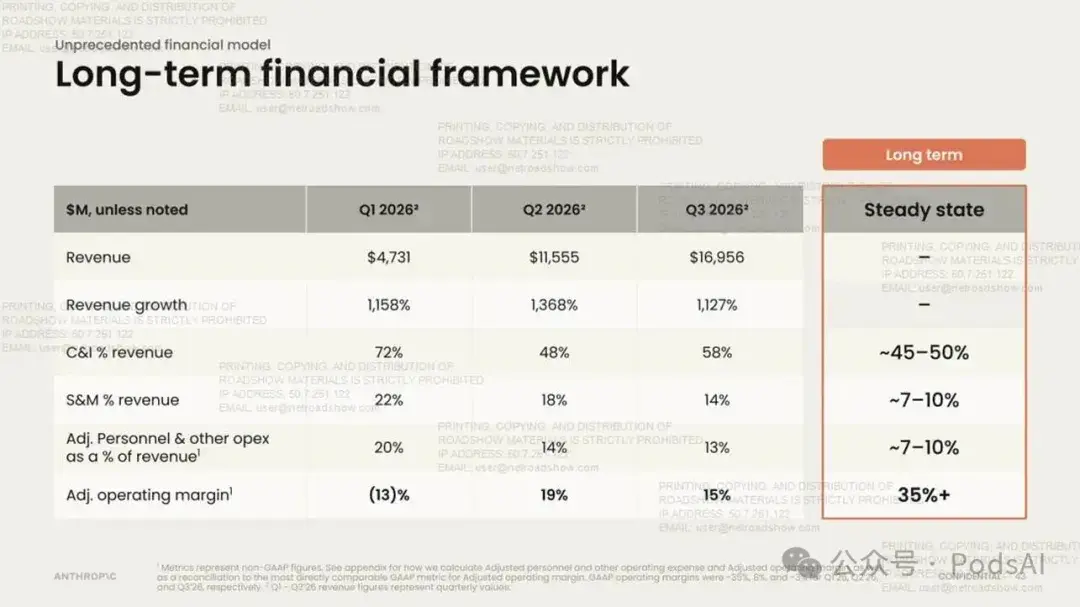
Finally, the long-term financial framework, which is Anthropic's long-term margin target for investors:
| $M, unless noted | Q1 2026 | Q2 2026 | Q3 2026 | Long-term steady state |
|---|---|---|---|---|
| Revenue | 4,731 | 11,555 | 16,956 | — |
| Revenue growth (YoY) | 1,158% | 1,368% | 1,127% | — |
| Compute & infrastructure, % of revenue | 72% | 48% | 58% | ~45–50% |
| Sales & marketing, % of revenue | 22% | 18% | 14% | ~7–10% |
| Adj. personnel & other opex, % of revenue | 20% | 14% | 13% | ~7–10% |
| Adj. operating margin | -13% | 19% | 15% | 35%+ |
The long-term target is an adjusted operating margin above 35%, and Rao laid out three paths to it. As efficiency keeps improving, Anthropic Direct takes a bigger share and more compute shifts from training to inference, compute and infrastructure should fall to 45–50% of revenue. As scale grows and cloud channel fees shrink as a share of revenue, sales, marketing and partner costs should fall to 7–10%. And as Claude raises team productivity and headcount grows efficiently, people and other costs should also fall to 7–10%.
Against Q3's actual numbers, the gap is mostly in compute. Compute was 58% of revenue in Q3, still well above the 45–50% target, and it is exactly the line that expensive short-term compute weighed on.
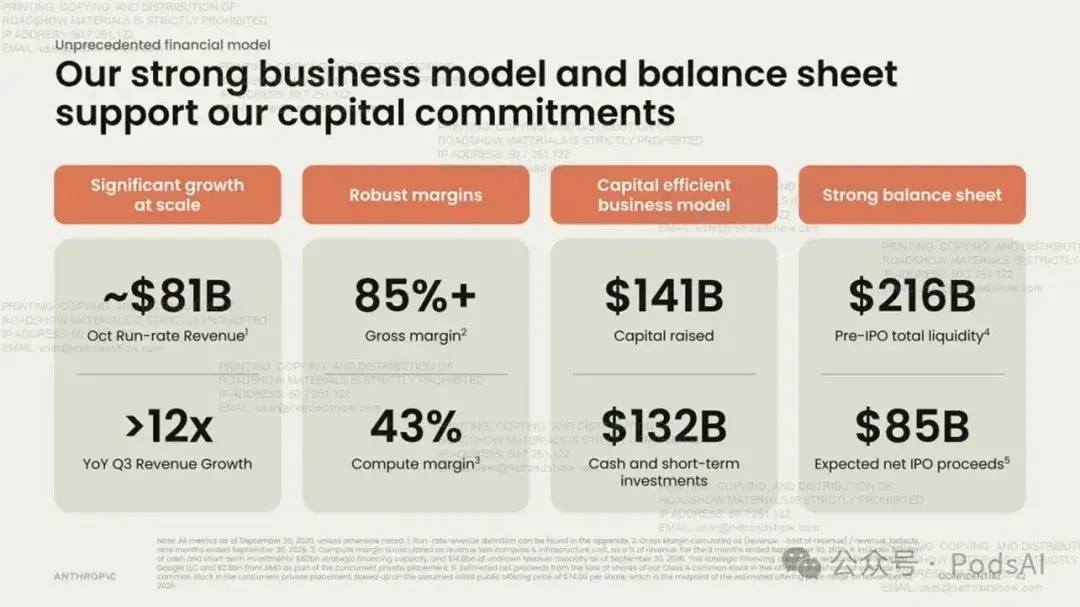
Now the balance sheet. Anthropic has raised $141B to date, holds $132B in cash and short-term investments, and has $216B in total pre-IPO liquidity. Besides cash, that $216B includes $82B of strategic financing capacity and $14.8B of undrawn revolver capacity. At the $74 midpoint of the price range, the IPO is expected to raise about $85B in net proceeds.
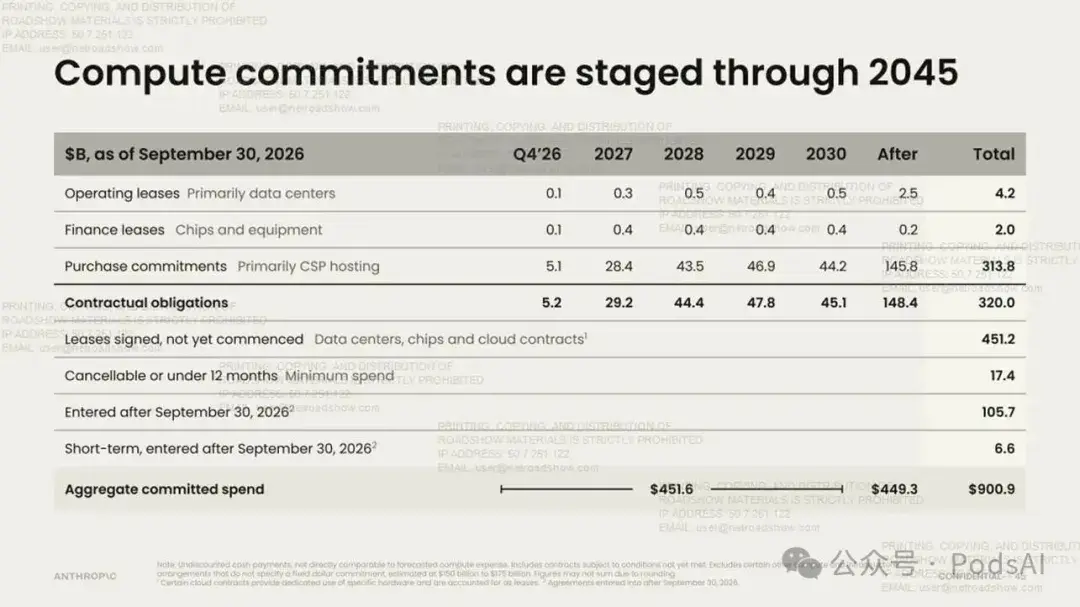
Why does it need so much money? The answer is in this appendix table. As of September 30, Anthropic had about $320B of compute commitments that are already contractual obligations, almost all of them purchase commitments for cloud hosting, totaling $313.8B. On top of that are $451.2B of data center, chip and cloud contracts that are signed but not yet started. Adding cancellable commitments and contracts signed after September 30 brings the total to about $900.9B, running through 2045.
This is the other side of the roadshow. Anthropic's growth story is impressive, but what it has put on the table is close to a trillion dollars in long-term compute contracts. Whether revenue can cover those commitments depends on whether the model capability curve keeps climbing.
5. Closing
The roadshow ended with Dario Amodei. "Cancer, Alzheimer's, heart disease, mental illness, the things we see today," he said, "I think will be things of the past in less than a decade." He also said the companies that handle the risks well will be the ones that earn society's license to operate, the ones society trusts and believes can create benefits the right way.
"If we get this right, we can open an age of wonders and let humanity solve problems that have troubled us for thousands of years. We have to be very careful about all the risks of this technology, all the ways it could go wrong, while bringing its benefits to the world and building a sustainable business."
Our take
As an AI security company, what we watched most closely in this roadshow was not the revenue but the role security plays in it. Four things stand out.
First, security is now part of the business case. When Bristol Myers Squibb and AIG explained why they chose Anthropic, they talked about observability, permission controls, human oversight and engagement with regulators, not about a few extra points on a benchmark. Those are the hurdles an enterprise has to clear before it puts AI into its core business. The CFO listed safety as one of three investment priorities and called it a business advantage. In the enterprise market, security capability now drives revenue directly; it is no longer just a compliance cost.
Second, finding vulnerabilities now outpaces fixing them. Mozilla fixed 271 bugs in a single release, the Cyber Verification Program has found more than 129,000 verified vulnerabilities, and Accenture cut scans from days to under an hour. AI finds flaws far faster than humans can patch them. Unless defenders automate triage, patching and verification too, the backlog will grow with every discovery. The flip side is that once the same capability reaches attackers, the window between a vulnerability being found and being exploited will shrink sharply. How long the defenders-only deployment of Mythos can hold is a question the whole industry needs to think about.
Third, models are reshaping their own R&D. Claude writes more than 90% of the code, Mythos ported a new chip platform in three days, and Claude is expected to discover compute multipliers "fully on its own." All of these were pitched as selling points, and Anthropic named "recursive self-improvement" outright. When a model is deeply involved in its own training, deployment and infrastructure, where its permission boundaries lie, how every action is audited and which steps must have a human review them become some of the central AI security questions of the next few years.
Fourth, agents are taking over critical, privileged workflows. From Claude Managed Agents, to end-to-end workflows where "people approve the output," to research assistants that query 30 to 40 medical and claims databases on their own, enterprises are handing more and more privileged actions to agents. What data an agent can reach, which tools it can call and how to trace what happened when something goes wrong are exactly the problems AI agent security has to solve, and what ClawGuard works on every day.
Short on time? Read the brief for the key points in 17 slides.
Based on Anthropic's November 2026 IPO roadshow video and slides, as published by PodsAI. Quotes are translated from PodsAI's Chinese transcript, not taken from the original English audio. Slide images carry the original publisher's watermark. Figures follow the roadshow remarks and slides and have not been checked line by line against the prospectus. This is not investment advice.